Thoughts on teaching, technology, learning and life in an era of change.

Archive for September, 2008

Teaching Australian history
September 22nd, 2008

Last weekend David Dale wrote an article in the Sydney Morning Herald regarding the teaching of Australian history in our schools. His article was prompted by the fact that the newly formed National Curriculum Board have commenced their meetings to start building a syllabus for History, English, Science and Mathematics. The new syllabus will come into effect in 2010. I am personally not sure how this new Board will achieve their goals given that they are only meeting on a few occasions and their numbers are few.

I personally have mixed emotions about the teaching of Australian history at present. More on that later.

I take exception to one Mr Dale’s statements, “Traditionally history lessons convinced kids Australia is one of the most boring places on the planet.” Which history lessons, Mr Dale? Elsewhere Mr Dale raises some good points. Yet, I wonder if he realises that all of the historical incidents that he listed in the article could not be taught in the current complusory Australian history course in NSW as they all took place before 1900?

Now, Australian history may not be as bloodthirsty or as thrilling as some episodes during the course of world history yet it is still possible to bring the content to life and make it relevant for the students.

One thing that annoys me about the teaching of Australian history here in NSW is that in recent years politicians have determined much of what and when we teach as opposed to historians and educators. This is frustrating. During the Howard years a jingoistic approach has crept into the teaching of the subject. Some politicians want teachers to be politically correct as we teach the subject.

I teach Australian history to Years 9 and 10 over a two year period. It is compulsory. I feel that the decision to make Australian history compulsory for students of Years 9 and 10 to be a poor decision. The syllabus content is tedious at times and admittedly it is challenging to engender interest and excitement in that specific content. The compulsory 100 hours of Australian history should be taught either to Years 7 and 8, either in a single 12 month period or over the two years in tandem with the Australian geography course. The Australian history taught should be comprehensive and not limited to the twentieth century.

Following that the Year 9 and 10 students should be allowed to select History as an elective. That elective subject should have a sweeping syllabus that covers world history, ancient through to modern and across all continents, including Australia. History should be an elective for the older students. The subject will attract a core of students interested in History. They can take that interest into senior subjects and then on to the community.

The politicians should leave the structure and content of the syllabus up to the teachers and not peddle their political or ideological agendas via our classrooms.

David Dale posed the question to his readers, “What should be in the core curriculum for Australian history?” A number of respondents suggest a wide range of topics and a number of students point out the boring aspects of the current syllabus. One students mentions how they are taught too much Australian history. This may not be entirely correct yet I can understand their sentiments given the structure of the syllabus.  We have limited hours in which to teach the course and as a result it is difficult to sink one’s teeth into the content.

A teacher Greg Leighton, put it rather well:

In NSW we have two constraints on good history teaching practice and they apply before any teacher gets into a classroom. Firstly, the Primary School syllabus limits Australian History content to the 19th Century if it is taught at all (with all the other subject and topics our overworked Primary teachers are required to do). Secondly, in High School we are limited to a shared (half) teaching load with Geography yet we still have a School Certificate exam. Because of this, content coverage is superficial in many areas in the interests of keeping our SC exam results at a satisfactory level. (Have a look at the SC Australian History exam sometime if you don’t believe the politicisation of the curriculum).

The ones who generally get forgotten are the students themselves, as has been shown by some of the earlier posts. I expect I’ll be howled down as one of those dreadfully biased teachers who ignores all the really important aspects of our history. However there are a lot of very dedicated History Teachers in NSW and no doubt across the country who would just like to be given a fair go at being able to deliver an interesting story that can both inspire as well as educate our students.

Other readers of David Dale’s article contributed salient points. Others did not. It makes an interesting read, particularly for teachers and students of Australian history.

And finally, one respondent Tony Flander made an impassioned plea that some of the lowest ebb of human decency should be taught. Do not worry Mr Flander, it is being taught. After all, History should at least engender in us all a desire not to repeat the errors of the past.


David Bowie ~ Dance
September 21st, 2008

Back in November 1985 David Bowie’s record company, EMI, had planned to release a compilation album featuring dance remixes from a couple of Bowie’s recent albums. The name of the album was imaginatively titled Dance [EMI ST-17175]. Each track on the proposed release was to receive additional production and mixing by Rusty Garner and Paul Sabu. The track listing was as follows:

Loving The Alien
Let’s Dance
Shake It
Blue Jean
China Girl
Dancing With The Big Boys
Modern Love

However, the album was withdrawn from EMI’s release schedule and it did not come to pass. No vinyl or CDs were pressed. A number of printer proofs for the sleeve were created. One of these was recently auctioned on eBay. Before all the sleeves for the album were destroyed a few were salvaged and others were used as packaging material for other albums as delivered to retail outlets. These were subsequently passed on to fans.

The sleeve artwork is not that brilliant and it seems that EMI was attempting to recapture the hype that surrounded Bowie in 1983 at the time of his hit album Let’s Dance and the Serious Moonlight Tour. Download a high resolution image of the sleeve.

Links:

BowieNet
Illustrated David Bowie discography
Bassman’s Bowie Page

Real, hard-working blogging communities
September 20th, 2008

Singaporean bloggers have been very hard at work in recent weeks and in particular this weekend.

First of all a group of Singaporean bloggers, known collectively as the ‘media socialists‘ have been quite busy. They are not ’socialists’ per se. They are a group of academics, civil servants, consultants and designers who are passionate and actively involved in social media, or what many people call “new media”. A group of the media socialists devoted a rather busy week creating a response, via a collaborative wiki, to the recent AIMS Consultation Paper advising the Singaporean government on engaging citizens through new media.

This form of collaboration and selfless sharing demonstrates how blogging and social media can be utilised to connect with governments and organisations. Individuals can come together collectively to achieve outcomes that would have been so difficult for an individual. Another group of Singaporean bloggers have also contributed to the debate. You can read all about the work of the media socialists here. I am heartened by the knowledge that the media socialists have included myself in their ranks due to my connections with the island state and personal friendships with a number of the actual bloggers.

I have been keeping tabs on their work via blogger extraordinaire, Kevin Lim. Now, who is Kevin Lim? He is a visionary, a researcher, a student and as he points out on his blog Kevin  “…is currently pursuing his doctoral degree in Communication at the University at Buffalo (SUNY). Dabbling for both pragmatic and play, he seeks an ideal interplay between online and offline life, through social networking, blogging and lifecasting. He openly wishes to become a “social cyborg”, where the meshing of human and networking technology would allow one’s presence to be augmented by the minds of many.”

On a separate front my friend Siva has been co-ordinating the International Coastal Cleanup Singapore. This involves 3000 volunteers. Blogging and connectedness play a crucial role in harnessing the volunteers, gathering data and publishing results. I remember back in 2001 and 2002 results were being published within minutes of the cleanup conclusion. Tonnes of rubbish are cleared away from beaches and mangroves during the cleanup.

Siva provides updates via his blog and the ICCS blog. The cleanup is happening today, as I type, and already several updates have been posted to the blog.

Siva uses blogging and the net to bring together students, teachers, and members of the community to work on environmental and other projects that benefit the people of Singapore. Siva has been using blogs as a tool to augment his research and teaching for at least five years now. Here are some of his blogs, those of his students and blogs that he contributes towards.

The Otterman ~ original blog
The Otterman ~ current blog
Habitat News
The Biology Refugia
LSM2351 Ecology and Environmental Processes
LSM1103 Biodiversity
LSM3261 Life Form and Function
LSM1301 Animal Behaviour
The Biodiversity Crew at NUS
The Pursuit of Anurans
Biodiversity of Insects at Kent Ridge
Fauna of Kent Ridge
Johora singaporensis
Frogs in Singapore
Horseshoe Crabs of Kranji
ToddyCats
Mangrove Shrimps of Kranji
Pasir Panjang Heritage
Singapore Heritage Blog

I would not be surprised that if one looked up the term blog in an illustrated dictionary there would be photographs of Siva and Kevin within the text of the definition. They are the definitive bloggers.

Most of all they achieve measurable outputs. They are productive. They assist the community. I wish I was in Singapore right now.

The Illawarra Escarpment
September 19th, 2008

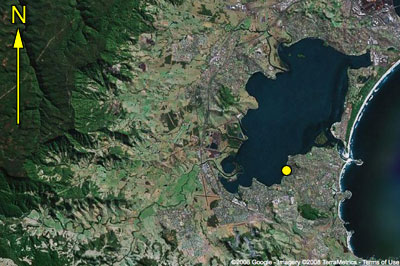
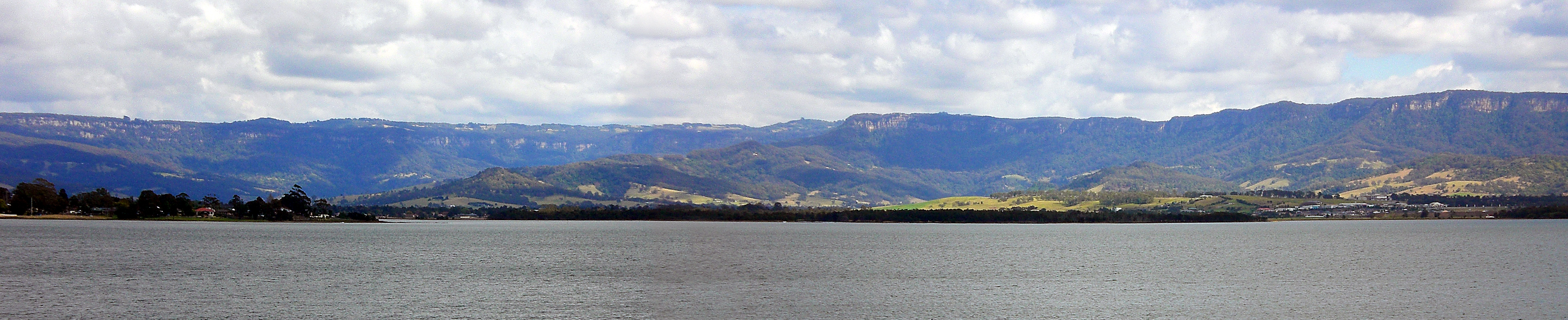
A couple of weeks ago the students of our school participated in a walkathon to raise money for several charities. The students walked along the southern shores of Lake Illawarra to the mouth of the lake where it meets the Pacific Ocean. The journey there and back was about 13 km. I took 23,748 steps according to a pedometer.

During the walk I took a few photographs with a small Casio digital pocket camera. I photographed the Illawarra escarpment. I was standing on the eastern shores of the lake and, pointing west, took a few photographs of the escarpment. I stitched a couple together using Photoshop Elements. To make up for the differing exposures I adjusted the levels slightly. The yellow spot on the Google Map above marks my approximate position.

Simply click on the image to download a high resolution copy of the panorama [4703 x 959 pixels at 72dpi ~ 1.7mb]

Blogging and edublogs workshop
September 17th, 2008

Conducted a blogging and edublogs workshop at St Vincent’s College in Potts Point, Sydney at the conclusion of the school day. Chris Morris, ICT Coordinator at the school, organised this workshop as part of a series of workshops that covered such areas as Second Life, Wikis, RSS feeds, Google Reader and Flickr. It was an excellent opportunity for staff to explore all of these possibilities.

I had the pleasure to work with a most interested and receptive group of teachers. I shared with them the possibilities and realities of blogging with students. Management issues were covered yet I also pointed out the advantages in simply allowing students to open their own edublog accounts and then to invite their own teacher to be co-author. Empowerment and responsibility.

The pro and cons of different types of blogs were raised during the workshop. My main message was to take small steps and gradually evolve from that point. The workshop was most enjoyable. I was most impressed with the staff, the students and the school.

While waiting for the Edublogs site to happen at various points during the workshop I whipped open a couple of tabs on the Firefox browser and shared Compfight and Posterous with the teachers. One of the best things was the fact that I simply conducted the workshop using the presentation desktop computer in the computer lab. I did not use my MacBook. The portability, accessibility and cross-platforn nature of all these tools is simply useful.

An updated edublogs workshop document and related presentation can be downloaded from this page.

Airfoil your streamed music
September 13th, 2008

One of my favourite sites on the Internet is Wolfgang’s Vault. “What is that?” you ask? It is one of the most incredible music sites on the web. It streams live concert audio archives going back 40 or more years. There are concerts by David Bowie, Neil Young, Led Zeppelin, Blondie, Devo, Allman Brothers Band, Joe Cocker and on and on. There are over 1740 concerts. Check out this listing…

Many of these shows were broadcast live on American radio networks. Some of you may remember the King Biscuit Flower Hour or the Superstar Concert Series? Quite often these radio broadcasts were recorded by fans on to tape and then bootlegged. One of my favourite bootlegs was Resurrection on 84th Street which featured a live performance by David Bowie that was recorded at the Nassau Coliseum in Uniondale on the 23rd March, 1976. I bought my copy from Toad Hall’s Rare Records in Victoria via the post. The double album set cost me $11.00AUD.

Anyway, portions of this show are now available at Wolfgang’s Vault. The band for the tour were tight. The shows were powerful. Bowie was really enjoying himself.

Every now and then I surf over to the vault and listen to a gig or two. It is incredible. The two Led Zeppelin shows from 1969 are brilliant.

Tonight I thought I would set up Airfoil on the Mac and play the streamed audio through my stereo via the wireless network. I have been playing my iTunes playlists over the wireless network for a while now. I should have set up Airfoil to broadcast the other audio on my Mac as well a long time ago.

This software is neat. You can select the different nodes on your network and adjust the volume and equalisation of the audio. Works on Windows too.

Historic Tale Construction Kit Tip Sheets
September 13th, 2008

During the last couple of weeks my Year Eights have had the chance to pay a few visits to one of our school computer labs. We have four Macintosh labs and they are almost constantly booked out. That is a good sign actually.

Anyway, I have been aching to share Historic Tale Construction Kit with my students and as our unit on the Middle Ages draws to a close I have booked them in to the labs and they have taken to the ‘kit’ rather enthusiastically.

I have created a couple of worksheets that the students can follow if they wish but, to be frank, one quick demo and a few hints is all they need. It is a little quirky at times. Sometimes a character element will freeze and cannot be deleted. There seems to be a limit to the number of elements one can include in a scene. These are very minor issues. It is quite a simple yet quite powerful little online programme. Links to the sheets below.

When they complete a scene I ask them to take a screen shot (as opposed to publishing it online), save the capture and then embed their collected scenes in Comic Life. [All you iPhone and iTouch fans might like to check out Comic Touch as well]

Of course, both Historic Tale Construction kit and Comic Life work just as well in a Windows environment.

At the end of the lesson I allow the class five minutes to play with PhotoBooth. I call it the PhotoBooth Moment. They enjoy it.

Links:

Historic Tale Construction Kit worksheet [doc]
Historic Tale Construction Kit tip sheet
[pdf]
Comic Life worksheet [doc]
Comic Life worksheet [pdf]
Earlier blog post on HTCK #1
Earlier blog post on HTCK #2

Why do you teach? Is it the subject or the students?
September 11th, 2008

Today I was speaking with an old friend. We were conversing about why people teach.

He mentioned that there must be teachers out there who joined the profession because they have a love or admiration of the subject matter and that the students are secondary to that motivating force. That statement intrigued me. Would there be teachers who enjoy the subject, say Science or Mathematics, and have become teachers simply to impart their knowledge and love of the subject? Where does that leave the students?

They added that people who join the profession specifically because they like to work with children are more likely to become primary school teachers as they are teaching a broad range of subjects. I wonder.

This photograph needs a new story
September 10th, 2008

I took this photograph in Boorowa in mid-western NSW, Australia. I was intrigued to see a sign pointing to Internet Access. I wondered how old it was.

Anyway, I think this photograph needs a new story. How would you use this photograph? It is yours to use. The high resolution original is here.

Sootie suffers a little hubris
September 9th, 2008

Sootie has discovered how to Google his own name and…

Twelve Canoes
September 8th, 2008

One of the most successful Australian films of recent years has been Ten Canoes. As the Wikpedia entry points out the film is “notable as the first full-length feature made entirely in an Indigenous Australian language. It was directed by Rolf de Heer and Peter Djigirr”. It is narrated by David Gulpilil and stars his son Jason. It provides rich insights into indigenous society and is an invaluable educational resource for all students.

Today a new web site, Twelve Canoes, was launched. It is an evolution from the film Ten Canoes and continues the stories of the Yolngu people of the Ramingining in the northern part of Central Arnhem Land. This regions is located in the Northern Territory, Australia.

It is a beautifully designed web site that incorporates multimedia and other interactive elements. It is an excellent oral history resource. It is still evolving and will provide a rich resource for educators from primary through to the tertiary sector.

Fish head
September 6th, 2008

Fish head in a microwave oven. It inspired me today. Has it inspired you?

Stormy Illawarra
September 6th, 2008

This afternoon Shao Ping and I took our homestays Jenny, Aya and Shiho for a drive to the ocean in order to view the high seas. We have had quite a good bit of rain during the last two days. I captured a quick movie of the seas.

Is there an easier way to password reset 60 edublogs?
September 5th, 2008

This week I set up 60 Edublogs for my two of my three Year Nine History classes. They are about to begin their time diaries. The students will hop into their own imaginative tardis and export their minds back to Australia of the 1930s and 1940s. They will keep a diary of their experiences during those turbulent times in Australia’s history.

My main aim was to add the 60 students as authors to the class blog and the easiest way to do so was to simply use the multiple Blog and User Creator in eduBlogs. I created the 60 blogs, 15 at a time. I created 60 student ‘temporary’ gmail accounts using that neat little short cut that is described here. You know the one…

yourmailaddress+studentname_01@gmail.com

I kept the students’ names, gmail account address, edublog username, edublog address and edublog password in a word document. I also subscribed to the 60 blogs in a Google Reader account od I could easily monitor the student progress.

I set the permissions for each blog and also the permissions for each of the students in the class blog. As you can imagine I devoted some time to these activities. When I first logged into edublogs to begin this process I had to reset the password of the main class blog due to a software upgrade. That only took a moment.

This morning I began to share the new edublogs with the students and I set about to demonstrate a blog set up for a fictitious student, Fred Ziffel. Anyway, upon logging in that message regarding regarding the software upgrade and password reset appeared and I initially thought,”Well, that is not a problem. The students can reset the password when they log in to their new blogs.”

But, then it hit me! I had used a single gmail account to create the blogs! I was the only person with access to that gmail account. I would have to reset the passwords for all 60 blogs myself. These are the steps I will need to take.

First of all I will need to log into the specific student account.

Then I will need to click on the link to reset the password.

Then I shall type in the student’s username.

Then I need to check the gmail account.

I will open the gmail account and read the message from edublogs.

I will click on the confirmation link.

I will be taken to this page where I will be asked to recheck my email for the new password.

I will then go back to the email to retrieve the new password.

I will open the email to obtain the new password.

I will record the new password in the word document.

I will need to repeat these steps for each of the 60 student blogs. If you know an easier way please let me know. I guess the Edublogs Campus edition is the real solution.

Boat Quay, Singapore
September 3rd, 2008

These photographs were taken at Boat Quay, Singapore. Years back it was a busy port with small boats and sampans lining the shores, busy with crews loading and unloading their cargoes. These days it is a tourist mecca with restaurants, bars and pubs. One can eat and drink outside, under the stars, by the Singapore River. It is busy of an evening and relatively quiet by day.

During my first job in Singapore the programmers, designers and I would occasionally set up camp in a quiet coffee shop by the river and work there, swapping files via a local wireless network set up by our Macs. Our office was a kilometre or so away in Chinatown.

Shao Ping and I did not go to Boat Quay all that often. We would take our visitors there for dinner or a drink. There are a few bars that are the haunts of expatriates that work in the CBD. I never felt that comfortable in those venues. I felt that there was an air or pretension in those places.

I took these two photographs with a Sony DSC-70 digital camera. I sat the camera on a stone fence and left the shutter open for a few seconds.