|
|
|
Thoughts on teaching, technology, learning and life in an era of change. |
Archive for
April, 2009
David Bowie ~ Station To Station Full Colour Artwork Revisited
April 22nd, 2009
Just on two years back I wrote a post about a particularly interesting album by David Bowie entitled Station To Station. That blog post attracts more comments than most on this blog.
The album was released in 1976. The album is excellent in its own right and marks Bowie’s transition from his US influenced ‘plastic soul’ period of Young Americans through to the experimentation of the Berlin influenced trilogy of Low, “Heroes” and Lodger. Bowie collaborated with Brian Eno on those albums.
My original post sets out the variations in the artwork that were planned for and finally graced the Station To Station album sleeve. The original artwork incorporated a full colour photograph of Bowie taken on the set of the film, The Man Who Fell To Earth. This artwork, apparently, was not favoured by Bowie and a cropped black and white incarnation of the photograph was utilised instead. That album sleeve is shown below. Some of you may own a copy.
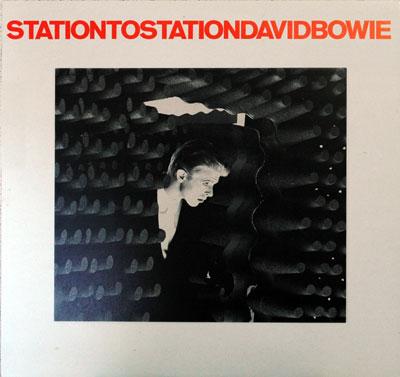
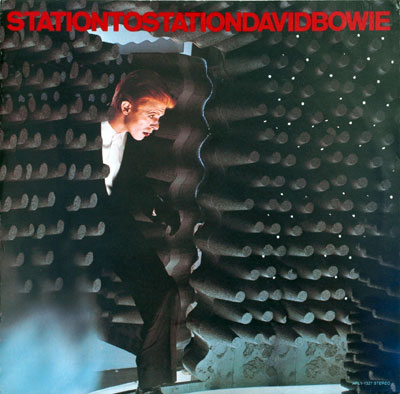
Many fans were oblivious to the existence of the full colour artwork until a copy was published in David Bowie: An Illustrated Record by Roy Carr and Charles Shaar Murray. The full colour artwork was an impressive revelation at the time and many wondered why the decision was made to go with the cropped black and white photograph.
Full colour printer proofs were produced by RCA in the USA in 1975. Michael Olsen, who was working for Bowie’s record company in 1975 obtained copies of the printer proofs amongst a collection of materials that the company felt was no longer needed. Michael himself commented about this on my earlier post. In addition to the RCA full colour proofs printed in the USA a number of 24″ X 12″ full colour flat mock-ups of the sleeve were produced by RCA in the UK and these were used by sales representatives to market the forthcoming album. One of these RCA UK mock-ups is illustrated below. Promotional posters printed at the time featured the full colour artwork as well.
During the late 1980s one of the full colour RCA proofs was sold or passed to a collector in the UK and it was utilised to produce a counterfeit of the full colour artwork. One could pick up a copy of the counterfeit sleeve for £10.00. As I commented on my original blog post the counterfeits were excellent and nicely reproduce the RCA USA colour proof. They were folded and glued and they were ubiquitous amongst Bowie fans from that time. Some collectors bought half a dozen or more. It was a genuine bargain. One of these counterfeits is illustrated below. I bought two.
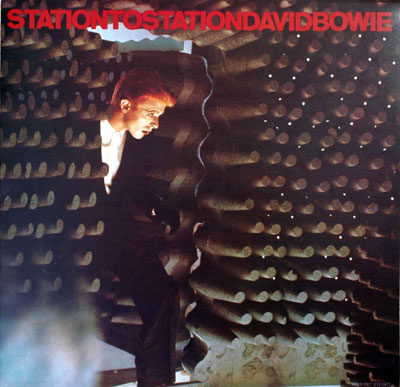
Most fans thought that they would never ever get to see a copy of the authentic artwork for the full colour Station To Station sleeve and when the counterfeit turned up it it was a real god-send. We all knew it was a counterfeit but we did not care. It was simply neat to have a copy and thus get an idea of what the full colour RCA sleeve would have looked like if it had actually been officially released.
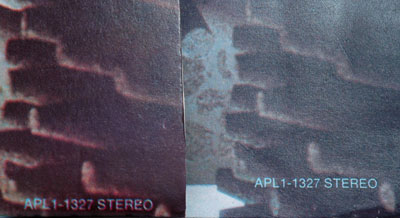
The counterfeit is a little flawed however. When one looks closely at the artwork it is blurred. The colours do not blend well and appear to be ‘bleeding’. This is illustrated below. The counterfeit is on the left. The official RCA product is on the right.
Well today, Jeff Gold, a famous record collector and dealer commented on that blog post as well. Jeff confirmed Michael’s account of the original colour proofs in the USA and shed light on yet another version of the Station To Station artwork that featured white lettering across the top of the album sleeve. A copy of that proof was placed on eBay today. I illustrate that proof below.
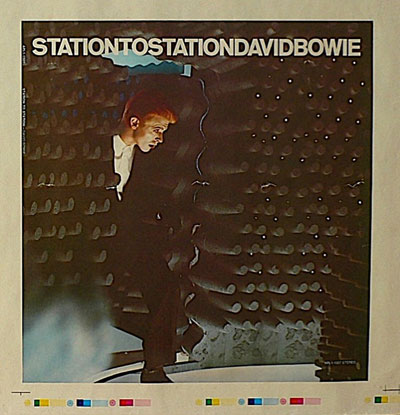
This new revelation adds another chapter to the history of this album sleeve. It will surprise many fans.
Finally, in order to confuse all of you further, when the Station To Station album was reissued with bonus tracks by both Ryko and also EMI during the 1990s they utilised the full colour artwork. A Japanese CD reissue in 2007 featured the black and white artwork.
Addendum. This is a photograph of the two late 1908s reproductions and the RCA UK flat mock-up, in the foreground, that I possess. The test pressing of the album is on the right.
Tags: artwork, Bowie, color, colour, counterfeit, sleeve, Station, stationtostation Posted in
Music |
4 Comments »

Lunch
April 12th, 2009
Had lunch at one of my old haunts in Trengannu Street near Pagoda Street in Chinatown, Singapore.
Rice, omelette with pork, vegetables and seafood. Tiger beer. A nice way to relax and watch the world go by for a bit.
Nostalgia. Been nearly ten years since I first ate at this establishment.

Sent via iPhone, with a little help from Posterous, to my blog, Twitter, Flickr, Facebook and Watershed Lite.
Posted via email from Watershed Lite
Posted in
Mobile, Singapore |
No Comments »
Down by the river…
April 12th, 2009
Went for a walk down by the Singapore River today. It was a overcast yet humid.
I eventually walked down to Pagoda Street to have some lunch. The gopuram on the Sri Mariamman temple is being renovated.
The Singapore River appeared quite brown today. Made for some contrast in the photographs. More to come.

Sent via iPhone with a little help from Posterous.
Posted via email from Watershed Lite
Posted in
Mobile, Singapore |
No Comments »


Avatars and educators
April 6th, 2009
Yesterday I raised the issue of avatars and educators on Twitter. I follow a number of teachers, social commentators, relatives and organisations on Twitter and vice versa. There is a wide variety of avatars among those that I follow.
A number of teachers and educators that I follow do not utilise a personal photograph for their avatar. Their avatars range from comic book characters through to line drawings, second-life portraits, logos and animals. Some educators utilise images of themselves taken as children or even images of their own children.
Personally I have utilised all of the images below. My current Twitter avatar is the final photograph on the right.

I utilise a portrait photograph as it represents me. What you see is what you get. As an educator, as a teacher I feel that is the correct approach for myself to take if I am to blog and tweet professionally.
I raised this point on Twitter and it generated a conversation between Lyndon Sharp and myself. I reproduce the conversation below in chronological order top to bottom.
John Larkin: My avatar was once a favourite photo of me as a young kid but then I felt it was a little weird. Some might feel it is misleading. Thoughts?
Lyndon Sharp: @john_larkin Twitter avatar choice: room here for PhD research project. Quirky? Cartoon? Provocative? School Yrbk approach? Best portrait?
John Larkin: @lyndons Initially I had no concern regarding the avatar of me as a youth but then felt it would possibly mislead.
John Larkin: @lyndons We teach our students to be wary of those they communicate with as they may not be what they seem. So, what about teacher avatars?
Lyndon Sharp: @john_larkin Avatar choice *is* as yet unstudied. Competing interests: need fr privacy, desire fr openness & projection of self-image…
John Larkin: @lyndons this idea re avatar is interesting. What are we trying to project? One’s employment can have an impact.
Lyndon Sharp: @john_larkin I get th feeling people more experienced in Social Media tend to choose something other thn a photo-portrait: a small privacy?
John Larkin: @lyndons yes, self-employed, consultants, etc have more latitude on their choice.
Perhaps, at Lyndon suggests, this question or issue could be the focus of a research project. If a teacher chooses to blog or publish online professionally in an open manner should their profile avatar be a reasonably recent portrait photograph or not?
Some may even feel that a portrait photograph is simply more professional. At least a recent photograph. What do you think? Is this too retrograde? Too conservative?
Should educators consider the views of other potential stakeholders: employers, students, parents?
Perhaps an educator is blogging incognito. Their choice of avatar may not be an issue in this case.
It is an interesting question. A possible conundrum. As Lyndon indicates there are competing interests.
What is your position on this? Not an issue? Free country?
Tags: avatars, Twitter Posted in
Teaching, Technology, Web 2.0 |
1 Comment »

Exploring sources in history via digital storytelling 2
April 4th, 2009
Earlier today I posted about a project designed to encourage students to gain an understanding of how sources in history can be utilised to build an argument or an account relating to an event, personality or period in history.
Back in 1996, together with artist Nathan Simpson, I created a fictitious landscape back that is bleak and empty of human life. The object for the students was to gather a variety of clues and piece together what has happened. I have reworked a few more images from the project and smaller copies of the same are displayed below together with those also posted earlier.
How would you use these images? A wiki? A blog? A dedicated web site? Allow the students to take the images and rework them and add additional clues?
The completed project will include additional images that depict the embedded clues in an enlarged format.
Simply based on the images shown below what do you think befell the denizens of this landscape?

Opening scene

Closer view of the town

Exterior view of house

Interior view of house

Exterior view of library

Interior view of library

Exterior view of metro rail station

Interior view of metro rail station

Exterior view of research laboratory

Interior view of research laboratory
Tags: digital, Nathan, Simpson, storytelling Posted in
History, Learning, Teaching, Technology |
No Comments »

Tweetie versus Twitterfon
April 4th, 2009
I installed Twitterfon on this iPhone tonight. I have been using Tweetie to monitor the Twitter stream.
Twitterfon incorporates a similar feature set and functionality as Tweetie. Twitterfon does feature an autofresh and an autoscroll to the previous update. They are handy.
Yet I still prefer Tweetie. It features an interface similar to the iChat app on the Mac as well as the Text (SMS) aapp on the iPhone. It is purely a visual thing. One other thing, embedded links in Tweetie are active and can be forwarded to other sources.
The initial image displays Twitterfon and the second Tweetie.


Tags: iPhone, Tweetie, Twitterfon Posted in
Technology, Web 2.0 |
1 Comment »

Exploring sources in history via digital storytelling
April 4th, 2009

Opening scene to “Hunger City” [1996][Large][Original]
Back in 1996 I created a HyperCard stack titled “Hunger City”. It was inpired by two factors. The first was David Bowie’s introductory sequence to the album Diamond Dogs, entitled Future Legend. The second factor was to create a tool that would allow students to explore a range of different types of evidence and then draw their own conclusion. This is a skill required of students in the study of history. They examine the various historical sources, look for accuracy, bias and the like and compose their views regarding the event, personality or subject matter. Science fiction crept into the story for this project as well.

I enlisted the assistance of a former student for this project, Nathan Simpson. I taught Nathan Introductory French language when he was in Year Eight back in 1987. Later I managed the school rock band, The Evicted, in which Nathan was the bass player. Nathan is an excellent artist and over the years we have collaborated on a number of projects. Nathan is an accomplished artist and worthy of your exploration. I shall be MC at his wedding later in the year.
I took Nathan’s original black and white sketches, that were created using pencil, ink, charcoal and toothpaste and reworked them using Photoshop.
Nathan created the original artwork for this HyperCard stack. We sat down together and I shared my storyboard ideas with Nathan. The vision was for a bleak city of the future without human survivors. I am resurrecting the artwork for an online version of the activity. I am reworking the graphics and updating the embedded evidence.

Key navigational elements in “Hunger City” [1996][Large]
When students explored the HyperCard stack they were able to collect “clues” and make notes. The desolate city that was the underlying metaphor for the ’story’ featured four areas that were enriched with clues: House, Library, Metro station and a Research Lab. The objective for the students was to determine what had happened to “Hunger City” and report back. I am updating this process with current tools in mind.
So, using the evidence presented in just the two scenes above what do you think happened to the denizens of “Hunger City”? There are many more scenes in the pipeline.
I am thinking of renaming “Hunger City”. What would you name this place? Mortopolis? The Place of the Dead? The Bleak?I would be happy to read your ideas.
Tags: City, digital, Hunger, Nathan, Simpson, storytelling Posted in
History, Learning, Teaching, Technology |
1 Comment »

Stephen Downes at UOW
April 3rd, 2009
I had the good fortune to attend a presentation given by Stephen Downes today at the University of Wollongong courtesy of the Faculty of Education. I once worked within the faculty as a member of the Interactive Multimedia Learning Laboratory a decade back. Much has changed within the faculty since those heady days. I digress. I live just a couple of kilometres away from the university by car.
It was good to bump into Ian Olney of the UOW as well as Gary Molloy from St Joseph’s at Hunters Hill and also Sui Fui John Mak of the Sydney Institute of TAFE. Gary and I later had a chat about activities at our respective schools. I also had the chance to catch up with Garry Hoban and meet Nicola Johnson, both of the Faculty of Education at the UOW. Nicola has blogged about the event as well.

Stephen with myself, Gary Molloy and Sui Fui John Mak

Garry Hoban, Stephen and Nicola Johnson
The title of Stephen’s presentation was Connectivist Learning and the Personal Learning Environment. As the abstract for the presentation set out Stephen spoke of the strategies that educators could employ to design learning for online delivery.
Stephen outlined the strategies employed by himself and George Siemens employed to conduct their Connectivism and Connective Knowledge course during the final quarter of last year. It was an interesting talk. Stephen’s presentation was personable, relaxed and enjoyable. Components of his presentation can be found within the body of these two recent presentations:
The Connectivism and Connective Knowledge Course
Connectivism: A Theory of Personal Learning
Stephen pointed out that the course attracted 2200 participants. He illustrated that the connectivist aspect of the process better suited courses with large enrollments as opposed to those with enrolments with, say, 30 students. It occurred to me that perhaps multiple tertiary institutions could deploy an approach to impart generic introductory course subjects. Faculty often teach those subjects when they have drawn the short straw. Staff could focus on the more topic specific subjects once freed up from the mass delivery of course opening materials. Just an idea.
The key ideas and approaches can be garnered from Stephen’s presentations. An approach in which the connections between participants within an open environment facilitate learning and not a simple shoveling of data across a student cohort.
A number managed to share a quick cuppa and a bite to eat with Stephen following the presentation. A good afternoon was had by all.
Tags: connectivism, Downes, Stephen Posted in
Learning, Teaching, Technology, Web 2.0 |
7 Comments »

|

|
|
|