|
|
|
Thoughts on teaching, technology, learning and life in an era of change. |
Archive for
February, 2009
Blogging, twitter and that audience
February 28th, 2009
Mark has written a post in which he evaluates Twitter and writes rather astutely about that audience that many bloggers and twitterers ponder upon, seek or desire. It is a good read, like all Mark’s blog posts. Mark is also great with video. Check this out. This one too. Anyway, I digress. Mark’s post about Twitter and his side note on the audience garnered a response from me and as I have done in the past I repeat those thoughts below.
Mark, a nice evaluation and thoroughly enjoyed reading the side note. Many of us have those thoughts, emotions, feelings regarding publishing on the net. It is only human.
The advice I have read and received is blog for yourself. Write for yourself. Simply blog about things you have done. The audience will come, whether you know it or not. It may be small or even large. That is not important.
Recently I have been focusing on that little group of bloggers and twitterers that comment on my blog and respond to my tweets. Do not worry about the ‘big knob’ bloggers out there. Who cares? Focus on that loyal group of followers or commentators. That is when it really kicks in.
I think you have the best Twitter avatar of them all. Is that you in the picture? Your avatar immediately grabs my attention and makes me take notice of what you have to say or share Mark. Blog on!
Cheers, John.
Tags: audience, publishing, Twitter, writing Posted in
Life, Web 2.0 |
2 Comments »

Grab that YouTube video via a single click
February 28th, 2009

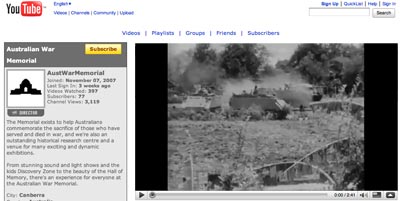
Australian War Memorial YouTube Channel
I discovered that the Australian War Memorial has its own channel on YouTube the other day when doing some research on the Vietnam War for a series of lessons designed for my Year 10 class. I showed the students a variety of video clips focused upon the Vietnam War. The clips were authored by war enthusiasts, students, news media outlets and several by the Australian War Memorial. I asked the students to compare the clips in terms of credibility, bias, usefulness and accuracy. Honing their Internet research skills and capacity for critical thinking, methinks.
This week several colleagues dropped by my desk with questions about PowerPoint and embedding video. Each had a different problem. It is a little weird when staff possess identical laptops and operating systems yet PowerPoint and video behave differently. Well, not that weird really. Typical if anything. That is another story.
I wanted to find an easy way for my colleagues to download the high quality video from YouTube that they could insert into their PowerPoint presentations, etc. From time to time one hears of different methods to download YouTube videos. MacUsers may like to use Tooble. http://tooble.tv/
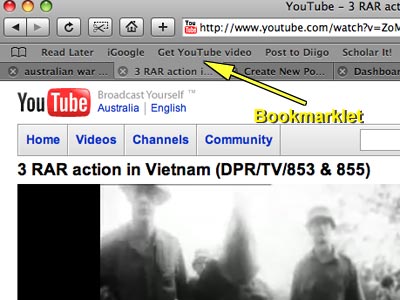
But then there is this nifty little button or “bookmarklet” that you can drag to your browser’s toolbar. It is located at this page on the GoogleSystem blog. This is “old news” but good news. Simply click and drag the rectangle that states “Get YouTube Video” to your browser’s toolbar and that’s it. Simple, elegant.

Get YouTube video bookmarklet in situ
Next time you visit YouTube and locate a video that meets your needs click on the “Get YouTube Video” bookmarklet on your browser’s toolbar. A download of the high quality version of the video will commence. The downloaded file will be in .mp4 format. The video will launch once the download had completed. You will need to rename that file. Each download has the same generic name which is “video.mp4″. The video will insert within a PowerPoint presentation.
Tags: critical, evaluate, thinking, video Posted in
History, Learning, Technology |
5 Comments »

Global v local, wired individualism v real communities
February 24th, 2009
Dean Groom has written a thoughtful post on infinite learning and the need for information literacy and schools that prepare students for the infinite world of information given the advent of the Internet. He writes of the Florida Virtual High School and its programme of personalised instruction. Dean mentions that perhaps a virtual HSC High School could be established here in New South Wales. Dean’s post prompted me to comment…
Dean, the Florida Virtual High School is an interesting concept. It has evolved from a distance education background and it certainly delivers a significant number of courses each year.
I cannot help but feel that “Personalised instruction” should be labelled “Tailored instruction”. Personalised instruction for me would be face to face tuition.
eLearning is an excellent vehicle for distributing knowledge and skills for those willing to learn. It allows opportunities for further education, particularly for those unable to travel or situated in remote areas. eLearning can also support existing face to face instruction.
A learning environment that is entirely online suits some, not all. Experience with eLearning programmes involving organisations such as the University of Wollongong, Nokia, Singapore Airlines, JPMorgan Bank and others illustrated for me the pros and cons of 100% online delivery of courses. I feel that face to face instruction is an important facet of the socialisation process of our youth. Schools provide opportunities to acquire skills in interacting and coping with your peers.
A virtual HSC High School that augments face to face instruction, supports students in remote areas and facilitates subjects with very low enrollments is a good idea yet I feel that students should still be engaged in a significant face to face component as well.
Infinite possibilities, true. Infinite learning? Infinite memory? Not so sure about that. I sometimes get the feeling that we are filling our lives with too much stuff. Endless streams consisting of immediate moments of gratification and tenuous connections. Too many choices in today’s world. information literacy should focus on instructing students how to filter out the unnecessary stuff and how to focus on media that can facilitate lifelong growth, community connections and local benefits.
Local is broken. It needs fixing. Global connections are fine yet let’s not lose sight of local, community, real neighbours. The infinite possibilities that are now available can be used to try and regenerate local connections and people stuff. Local is becoming the poor brother of global.
Wired individualism versus real communities.
Cheers, John.
Posted in
Learning, Life, Technology |
2 Comments »

Productive communities or wired individualism?
February 22nd, 2009
Chris Lehmann has composed a post in which he speaks of the need to be proactive as opposed to reactive in the lives of the young as they ‘navigate the world’. I responded to Chris’ post with the following comment and I thought why not reproduce my thoughts here…
Agreed, a proactive approach is required. Our students, the kids, require good exemplars and direction. They have taken to MySpace, Facebook, and other publishing platforms with a passion. Educators and responsible adults need to illustrate how these publishing tools and others such as blogs can be utilised to create communities that give to society, that are productive and helpful. Collaborative communities that benefit society and not wired individualism that seemingly takes from society.
Tags: collaboration, communities, direction Posted in
Learning, Life, Teaching, Technology |
No Comments »

A tweet from Pompeii 79AD
February 21st, 2009

Source: Historical Tweets
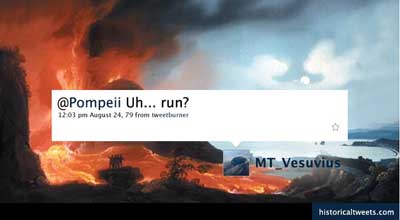
A post by Francesca Tonchin in Classical Archaeology News just alerted me to Historical Tweets. The specific tweet relates to the eruption of Mount Vesuvius in 79AD and the consequent disaster that befell Pompeii, Herculaneum and other regions of Campania. [This event and the societies of Pompeii and Herculaneum are a core unit of the Ancient History course in the New South Wales Higher School Certificate.]
The idea generated some thought and made me wonder about other possible applications such as “Famous Last Tweets”. Imagine asking students of literature, during a break or diversion in that programmed syllabus, to compose tweets that would have been written by writers such as Plato, Lawrence, Dickens, Twain, Pepys, Shakespeare, Orwell, Donne, and so on. I believe John Donne’s tweets could have been particularly telling…. “This bed has fleas…” or “Just picked up a nice compass“.
Care to suggest others?
Tags: authors, Donne, literature Posted in
History, Learning, Teaching, Web 2.0 |
5 Comments »

The bombing of Darwin 1942
February 19th, 2009
On the 19th February, 1942, the city of Darwin in Australia’s Northern Territory was bombed by Japanese military aircraft. Two bombing raids took place. It was just four days after the fall of Singapore. The bombing raids were led by the same commander that presided over the attack on Pearl Harbor on the 7th December, 1941.
At least 243 people were killed during the raids. The casualty list published in newspapers at the time was much lower so that the Australian public would not be alarmed and panic. This bombing raid was followed by countless more at various points across Australia’s northern coastline. Towns such as Exmouth, Broome and Townsville were bombed during this period.
There are some informative resources regarding these attacks that teachers and students would find useful. There is Australia Under Attack at the anzacday.org.au site. This section is a subset of the Battle for Australia component of the site. There are a number of photographs that educators and students can also freely use as long as they acknowledge the Australian War Memorial. One such image from the web site is displayed below.

AWM 026977 Damaged RAAF hangar. A Douglas dive bomber lies in ruins.
The Australian War Memorial also has a valuable suite of resources including the article, Australia bombed, strafed and shelled. It incorporates a map illustrating sites that were attacked around the Australian coastline. Of course you can always conduct a search for resources at the Australian War Memorial.
The National Archives of Australia have some great primary sources, including newspaper reports and various original documents of the event.
Additional resources and sites:
The Japanese bombing of Darwin and northern Australia
Photographs of the bombing of Darwin
Bombing of Darwin ~ Wikipedia
Please feel free to suggest more resources by posting a comment.
Posted in
History, Learning, Teaching |
1 Comment »

Passenger or driver?
February 1st, 2009
I met Darcy Moore the other day. I enjoy reading Darcy’s blog and catching up on his tweets. We grabbed a brew at the Laconia coffee lounge in Kiama. I like that place. Like stepping back in time as you stir your coffee, complete with a real cup and saucer, as you sit in one of those luxurious booths that hark back to the glory days of the 1950s.

Our conversation covered career, driving and the change that is happening with the Internet and mobile technologies. The other day Darcy gave a presentation at the Illawarra and South East Regional Conference (DET). As Darcy wrote on his blog his “aim was to propose a way that educators could engage students using new tools by transforming professional development in the ISER region with Web 2.0 concepts”. Darcy’s post is an informative read and a number of great comments have been added to the post. I suggest you give Darcy’s post a read and add to the conversation. I commented as well and I thought I would take my words and repeat them here…
Darcy, your drive and passion will have an impact. You have sown the seeds and now is the time to nurture the growth and spread the thinking, rationale and implementations of the programme set out above. Incremental yet formative steps.
Change is underway in how many members of society communicate and act. Individuals are no longer simply the passive recipients of news and information. They now have the power to publish and disseminate information. Passive has been replaced by proactive. That entails a measure of responsibility.
Decision making and choice was often imposed upon society via marketing and regulation. Now, via the web, individuals have the ability to make change occur from the ground up via rapid publication and the sharing of their views and decisions. Ideas and actions, both good and bad, can be disseminated quickly and efficiently.
Technology has provided society with a new swathe of communication and publication skill sets. These new skills have arrived rapidly. Much can be achieved with the change that is taking place with respect to the empowerment of the individual and the group facilitated via the changing use of the Internet. The wise and beneficial use of these skills as positive change agents within society predicate that good exemplars and education is required.
The Internet as a platform has changed. individuals are not simply an audience observing a performance on stage. They now have the potential to be part of the performance whether they be actors, writers, directors or producers. Education has a role to play in facilitating the staging of a good performance.
Think upon the car. A rapid impact on society. Imagine driving on the roads if driver education had not taken place. Not the best of similes yet I feel that the evolution of the Internet as a media that primarily facilitated consumption to one that fosters participation educators (and also those elected to oversee the functioning of our society) cannot simply sit back and watch it happen. They need to be involved and, at least, to understand. Comprehension of the change can facilitate sound judgement and the provision of good exemplars for students, colleagues and the wider community.
On another level the Internet and mobile technologies have collectively allowed the individual to be either a passenger or a driver on this new road. Our students have already made the decision to be drivers. The ride can either be bumpy or smooth. Would you rather be a passenger or a driver? Certainly not hiding in the boot of the car.
Compulsory PD re Web 2.0? Will it happen? Frankly, I am not sure. Perhaps, like the car, the impact on society of Web 2.0 will become so significant and so pervasive that educators will want to secure that license and learn how to drive it anyway. Not all, but many.
We all need to grab a map, buckle up, turn that ignition key and make the journey happen otherwise we will be left behind, standing at the kerb, and observing opportunity as it disappears over the horizon.
Posted in
Learning, Teaching, Technology, Web 2.0 |
3 Comments »

|

|
|
|