Thoughts on teaching, learning, technology and life in an era of change.

Archive for October, 2007

How can a teacher integrate Web 2.0 technologies into the curriculum?
October 30th, 2007

Who do you teach? Primary school aged students? Secondary school students? Tertiary students? I teach secondary schools students. I teach history. I have also taught a number of other subjects. How can you integrate Web 2.0 technologies into a teaching and learning programme? How can you weave Web 2.0 tools into your lessons. I have some ideas I would like to share.

Recently I developed a teaching programme that I would like to call an Integrated Teaching and Learning Unit. It is incomplete. A work in progress.

It covers three different key learning areas (KLA) of the syllabus taught in secondary schools in NSW, Australia. The three KLAs are History, Geography and Technology & Applied Science (TAS). A number of Web 2.0 technologies are incorporated into the teaching unit. They include:

Wikis
Blogs
Twitter
Jaiku
Podcasting
Google Reader
Google Maps
Swickis

Additional tools include Excel, Photoshop and Comic Life for example. The ITLU is designed for a unit entirely conducted in a school with a One To One computing environment.

I am yet to develop assessment tools for the project. The teaching programme is designed to cover five weeks with 2 hours devoted to the project each school day.
Feel free to explore the sample ITLU which I have also linked to my Web 2.0 web page. I would like to hear what you do in your schools to embed Web 2.0 technologies in your curriculum. Feel free to provide feedback on the programme.
Setting up blogs for my students ~ how was it done?
October 29th, 2007

I wished to set up some blogs for my middle secondary History students. I did some investigation. I considered some of the educational blogging services but discovered, for example, that once I had exceeded 50 student blogs, that fees kicked in for the school. In other cases there was a lack of control. How could one set up about 60 student blogs? Well this is how I did it. This time. I will do it a little differently next time but this project has not yet completed.

I wished to assert a measure of control over what was published and how. Some readers may disagree with that. I am not referring to some form of political censorship. I have good reasons to justify the level of control I seek. Several years ago a case came to light in a nearby school in which students had utilised a blog to publish inappropriate images and comments. The term ‘blog’ became an unsavoury word in local education circles so I put the idea of establishing student blogs to one side and focused on projects using tools such as Photoshop, Comic Life and Audacity. As well, some students can simply not help themselves. They lack an understanding of the responsibilities involved with publishing. I needed to maintain close supervision over those students and their work.

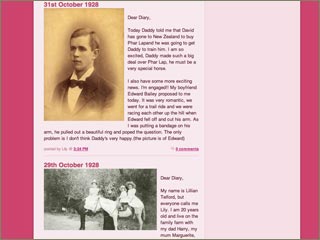
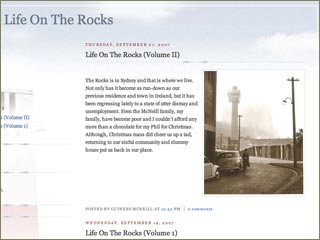
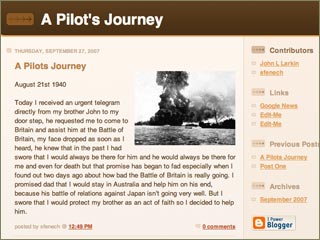
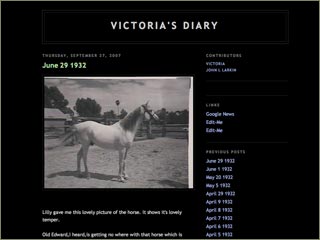
Well, a couple of years have passed and last term I felt that it was time to set up the blogging idea again. I wanted my middle secondary students to compose online diaries as if they were living through the Great Depression and/or the Second World War. I explored some blogging possibilities and I went with Blogger.

I set up the Blogger accounts for each student. There were 54 in all. That took two separate evenings. I created a simple initial welcome post in each blog. I created a sample blog that illustrated the sort of product that I would like to see the students begin with as they started blogging. I was then hoping that they would become more creative as they proceeded with the blog.

The next day in class I asked the students to list their student email accounts in turn in a spreadsheet. I showed them the sample blog and how they would need to post a blog entry. I invited each student to pick a template for their blog as well.

That night I invited each student to be an author of their blog. i would be the administrator. The following day I had booked the students (two separate classes) into two separate computer labs at school to begin blogging. There were some technical problems but all of that has since been sorted and a subsequent visit was more fruitful. The holidays then intervened. I was away as well and now that the fourth term has commenced I shall encourage the students to start blogging again. I have a role to play there.

As a measure of control each blog is published to my own server. I am notified of each blog post via a RSS newsreader. Comments will come to me via email for vetting. Finally, I eliminated that problematical menu bar and Next Blog button. The Next Blog button had the potential to browse to a distasteful blog. I use the following code just before the default code and after the name of the template creator to block the Blogger Navigation bar:

#navbar-iframe {
display: none !important;
}

The exact detail regarding how to achieve this is described at this web site.

I added an additional level of protection by publishing the blogs in a directory that cannot be accessed by googlebots and the like due to the inclusion of a ‘robots.txt’ file with the appropriate code. The blogs cannot be found in a search engine. When the project is over the blogs will be published. This sounds like a lot of control and overkill and probably is but the unfortunate episodes in the past in our district called for this degree of oversight. The blogs will eventually be published and the school community will get to see them. Just for now I just wish to see the students enjoying the process of creatively writing via a different medium. They understand why I have set up these safeguards.

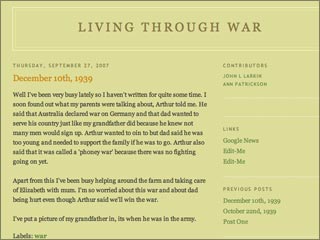
The students have started blogging and about a dozen have really sunk their teeth into the project. many of the students have only made one post. Others have not posted anything at all. I shall chase them up and seek out the reasons. That is my job. And an enjoyable job I might add. Squeezing this project within the normal programming of the subject is challenging but I am getting there, gradually. I have added some screen shots below.


From a historical perspective it is interesting as the blog entries are sprinkled with dating errors, anachronisms and other anomalies which will certainly provide a source of fruitful analysis when the students share their blogs in class. I hope that additional graphics and media such as audio and video are added to the blogs in future. I shall keep ypu posted on developments. I seek your comments on this process.

Annoying feature in Leopard ~ screen shots include a border
October 28th, 2007

I have taken a few screen shots in Leopard this weekend and I notice that when you do a screen grab of a window by pressing the space bar during the capture process it creates a border around the window.

As a png it is transparent but once you convert it to jpg you will see the border. This is annoying as I create a lot of screen grabs that I then copy and paste into word documents. This is a curious move by Apple. The border becomes apparent when you directly paste the image from the clipboard into another application.

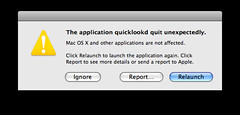
With reference to the image above the app that must have crashed was Quick Look as I was previewing an image taken in PhotoBooth.

Blogged with Flock

Leopard update glitches
October 27th, 2007

Well, I managed to install Leopard on the Mac last night. I updated the apps this morning. I reinstalled most of the applications, not all. Time to rationalise. The installation was painless. Some of the applications have not behaved well. iMovie would not launch at all. I performed a software update and installed the latest versions of most of the iLife apps. iMovie performed well after that.

Another nice little application that I use to manage audio input and output from Rogue Amoeba called Sound Source is not functioning at all.


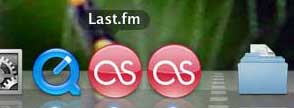
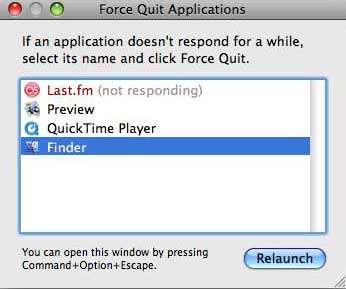
LastFM is also exhibiting an interesting reaction to the update. It launches fine yet it seems to open twice. You can quit the application yet the the ‘phantom’ copy will not quit. In fact one cannot even force it to quit. It finally gives up the ghost a few moments after an attempt at force quit. Will keep an eye on updates. Kevin Lim blogged on Leopard yesterday and elicited a range of interesting responses.

Leopard launched in Wollongong at Mac1
October 26th, 2007

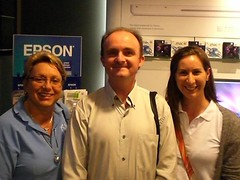
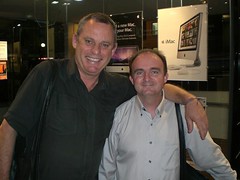
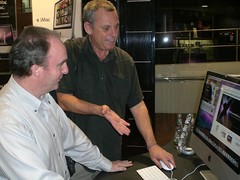
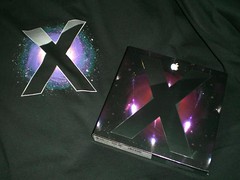
Attended the launch of Leopard, the latest version of Apple’s OS. It was held at Mac1, Wollongong, this evening. I had pre-ordered a copy. Receieved a free T-shirt as well. All of the usual suspects were there.


leopard_launch_3.JPG

David, Ken and David.

leopard_launch_1.JPG

Bernadette, myself and Julie

leopard_launch_4.JPG

Ken and myself

leopard_launch_2.JPG

Ken and I posing for the camera… pathetic.

leopard_launch_5.JPG

The T-shirt and the packaging.

The "Digital Natives" Debate Continues…
October 23rd, 2007

Back in September I wrote a post concerning the premise that adults, including teachers, are “Digital Immigrants” and that the students that we teach are “Digital Natives”. This terminology was coined by Marc Prensky some time back. I have used the terminology on a number of occasions myself. During the last couple of years, having worked closely with secondary school students, I have begun questioning the premise that underlies the terminology. In my original post I concluded that “perhaps they are not Digital Natives at all but simply Digital Dilettantes… they are, and I quote from a dictionary, an amateur or dabbler; especially, one who follows an art or a branch of knowledge sporadically, superficially, or for amusement only.”

Last Saturday David Thornburg wrote a post where he expresses regret that he had utilised the terms in the past. He also wrote that the terms were demeaning to educators. As he points out it is true that today’s students have grown up in a world where computers are reasonably ubiquitous but one cannot assume that this fact makes the students any more tech savvy than their teachers, or parents, for that matter.

The author of the Connectivism Blog has written an article critical of Marc Prensky’s position. He picks up on David Thornburg’s apology regarding the terminology as well. I cannot do it justice here. I strongly recommend that all interested parties read his views. He concludes “…aside from insulting an entire generation and coddling to the needs of younger learners, Prensky doesn’t provide us with a compelling model forward (other than “use digital games”).”

The author also makes a reference to “technology weariness” and “resistance to technology” among educators. He adds that hyped-up educational technology that fails the promise to deliver will only hurt future applications of these processes in teaching and learning.

I am now going to read Jamie McKenzie’s critique of Marc Prensky’s position in his article, “Digital Nativism, Digital Delusions and Digital Deprivation.” Jamie sets out, point by point, his views regarding Marc Prensky’s position.

Readers may think it curious that a teacher that readily incorporates technologies in the teaching and learning curriculum should post articles that seemingly go against the grain. Many major speakers and evangelists preach the premise that our students are the “digital natives”. I do not believe that we can make this blanket assertion for all students. I am a not alone in this belief.

I believe in a pragmatic and commonsense approach to educational technologies. [This is beginning to sound like a creed]. I have seen hundred of thousands of dollars pumped into multimedia and eLearning projects that are now idle. I have seen revenues in excess of six figures devoted to eLearning projects that are now obsolete (in under five years). I feel that is such a waste. I am yet to crystallise my approach but I essentially believe that educational technologies must only be incorporated into the teaching and learning curriuclum when it is appropriate and not simply “becasue it was there”. The application of the technology should

  • exactly match the specific knowledge, skill and attitudinal outcomes
  • complement, and not exclude, other tactics and strategies, traditional and otherwise
Perhaps I have achieved success with my recurring educational technology workshops in Sinagpore due to my pragmatic approach. I approach each workshop from the perspective of a down-to-earth and busy teacher. A realistic approach should be taken with the tool that is educational technology. Practical considerations should be weighed up above all else.
Flock
October 22nd, 2007

Installed Flock on the weekend. It is a cross between a browser and a feed manager. Kevin Lim had posted about the latest version and I thought it was wise to have another look at the tool

One neat trick. It allows you to save images to a temporary clip browser. I took a screen shot of the Flock window and in moments it was posted on Flickr and embedded in a blog post. I am even posting to this blog via Flock. That is quite handy.

As Kevin pointed out the latest version of Flock can be downloaded here.

Blogged with Flock

Record Collector Article about David Bowie Published
October 17th, 2007

Earlier this year I had the good fortune to collaborate on an article about David Bowie. He turned 60 this year and the article focused on 60 rare and intriguing recordings released during his career from 1964 through to the present. The article was published a couple of weeks ago in the Record Collector magazine.


I worked with Ruud Altenburg and Maarten Kwant, both of the Netherlands. We all had a great time writing the article and gathering together the images used throughout. Quite an experience and a further demonstration of the power of the Internet. The three of us have never actually met in person. We met via the web due to our interest in collecting records. Ruud is the creator of the excellent Illustrated db Discography. The article rated a couple of mentions on Bowie’s web site as well.

Vodcasting in a few easy steps
October 17th, 2007

During the last couple of years I have been conducting a variety of podcasting and vodcasting workshops. There was always two elements that proved challenging for the particpants. One was the process of ftp and the other was vodcasting on a Windows platform. There is a nice solution to both of these dilemmas. In a nutshell it is as follows:

1. Record your video using a digital video camera and process the digital video using iMovie (Mac), Windows Movie Maker (Win), Adobe Premiere and so on. Yoiu could also record the video directly using a web cam or iSight (Mac).
2. Upload the video to a Blogger blog within a typical post.
3. Obtain the RSS feed address for the blog and subscribe to it using the “Subscribe To Podcast” menu item in iTunes. The video feed within the blog will be accessed by iTunes and the embedded videos will be downloaded.

You can set up a blog following these instructions and then create a vodcast by reading these instructions.

Blogrolls generated via Google Reader
October 17th, 2007

I use Google Reader to scan through a variety of education blogs. Tonight I set up two blogrolls on this page using the instructions on this Google blog. The interface is not brilliant but I managed to add “tags” to the relevant feeds. They became folders which I could then use as the basis for each blogroll. The fact that an OPML file is created as well is quite useful.