Thoughts on teaching, technology, learning and life in an era of change.

Archive for the ‘ Learning ’ Category

Yes! The Digital Natives debate is alive and well…
January 8th, 2009

I am always happy to see the Digital Immigrants~Digital Natives debate back on the front page of blogs. I remember reading Marc Prensky’s original article that proposed the immigrants~natives idea when I was an instructional designer with the now defunct eLearning company ICUS (it was acquired by Academee). I was designing eLearning sites for Nokia and Singapore Airlines back then.

The other day Chris Betcher shared a range of views on this debate that echo my sentiments exactly. Beautifully. Please head over to his informative Betchablog to consume his well composed thoughts.

As I commented over on Chris’ blog this immigrants~natives debate is a recurring theme for me. My return to the classroom was an anti-climax in many respects. I was hoping to achieve wonders with the students following my technological sojourn at university and whilst working in Singapore.

I was surprised to find that the secondary school population was not overflowing with digital natives hungry for cutting edge challenges in a digital sense. In fact there was and is a sizable group that just want notes on the board and to be told what to study for in the exam.

I once wrote a post concerning the premise that adults, including teachers, are “Digital Immigrants” and that the students that we teach are “Digital Natives”. This terminology was coined by Marc Prensky some time back. I have used the terminology on a number of occasions myself. During the last couple of years, having worked closely with secondary school students, I have begun questioning the premise that underlies the terminology. In that original post I concluded that “perhaps they are not Digital Natives at all but simply Digital Dilettantes… they are, and I quote from a dictionary, an amateur or dabbler; especially, one who follows an art or a branch of knowledge sporadically, superficially, or for amusement only.” 

I would like to complement Chris’ thoughts with my own and to that end I reproduce some of the words I had put down back then…

“Last Saturday David Thornburg wrote a post where he expresses regret that he had utilised the terms in the past. He also wrote that the terms were demeaning to educators. As he points out it is true that today’s students have grown up in a world where computers are reasonably ubiquitous but one cannot assume that this fact makes the students any more tech savvy than their teachers, or parents, for that matter.

The author of the Connectivism Blog has written an article critical of Marc Prensky’s position. He picks up on David Thornburg’s apology regarding the terminology as well. I cannot do it justice here. I strongly recommend that all interested parties read his views. He concludes “…aside from insulting an entire generation and coddling to the needs of younger learners, Prensky doesn’t provide us with a compelling model forward (other than “use digital games”).”

The author also makes a reference to “technology weariness” and “resistance to technology” among educators. He adds that hyped-up educational technology that fails the promise to deliver will only hurt future applications of these processes in teaching and learning.

I am now going to read Jamie McKenzie’s critique of Marc Prensky’s position in his article, “Digital Nativism, Digital Delusions and Digital Deprivation.” Jamie sets out, point by point, his views regarding Marc Prensky’s position.

Readers may think it curious that a teacher that readily incorporates technologies in the teaching and learning curriculum should post articles that seemingly go against the grain. Many major speakers and evangelists preach the premise that our students are the “digital natives”. I do not believe that we can make this blanket assertion for all students. I am a not alone in this belief.

I believe in a pragmatic and commonsense approach to educational technologies. [This is beginning to sound like a creed]. I have seen hundred of thousands of dollars pumped into multimedia and eLearning projects that are now idle. I have seen revenues in excess of six figures devoted to eLearning projects that are now obsolete (in under five years). I feel that is such a waste. I am yet to crystallise my approach but I essentially believe that educational technologies must only be incorporated into the teaching and learning curriuclum when it is appropriate and not simply “becasue it was there”. The application of the technology should

  • exactly match the specific knowledge, skill and attitudinal outcomes
  • complement, and not exclude, other tactics and strategies, traditional and otherwise
Perhaps I have achieved success with my recurring educational technology workshops in Singapore and elsewhere due to my pragmatic approach. I approach each workshop from the perspective of a down-to-earth and busy teacher. A realistic approach should be taken with the tool that is educational technology. Practical considerations should be weighed up above all else.”
Getting started ~ putting knowledge into practice
December 19th, 2008

During the afternoon I gave a presentation via the Net to a group of teachers gathered together in Ungarie in far western NSW, Australia. They were attending a two-day Weaving Technology workshop. The title of the presentation was “Getting started ~ putting knowledge into practice”. The presentation was in conjunction with the NSW CAP programme, the DET and the Weaving Technology group. Anne-Maree Moore and Stacey Kelly were the prime movers behind the day.

A number of educators worked with the teachers during the last two days. In addition to Anne-Maree and Stacey the participants heard from Adam Currey, Phil Nosworthy, Darron Watt and Greg Alchin. A couple of new tools were brought to my attention during the two days: Kahootz and Shoutem.

The workshops that happened in Ungarie were a follow up to the excellent Weaving Technology conference that was held in Wagga, NSW, Australia last October. Following that conference I composed a few ideas regarding the thought or process of getting started with technology in the classroom. I blogged about those ideas at the time.

Essentially, when starting out with technology in the classroom I feel it is useful to keep the following three rules of thumb in mind…

1. Choose an aspect of the curriculum with which you hold a passion.
2. Choose an online tool with which you feel comfortable or ‘clicks’ for you.
3. Steer a simple, straightforward path at the outset.

As well, timing is also important… For example I find term III is favourable moment when the pressure is off somewhat. No final exams and no reports to write.

I pointed the participants in today’s presentation to the following resources…

Web 2.0 links and resources: Here you will find online guides and resources for applications and tools as diverse as Twitter, Second Life, Wikis and more. There are links to classroom blogs, wikis, Second Life sites, teacher blogs and a variety of advice from educators near and far. I have just updated the list with additional Nings and Twitter resources.

How to guides. This page is chock-a-block full of pdf guides to blogs, wikis, Twitter, RSS feeds, Posterous and much more. Feel free to download and use these guides. Worpdress has just been updated so that guide is a little out of date. I have also added these resources to my home page.

Blogrolls. These are some of the blogs that I read some of the time, not all of the time. This needs updating. Need to import my latest OPML file into Google Reader.

I have also uploaded four rough edits of an interview recorded by Nanyang Technological University. Four questions were answered. These videos could have acted as a back-up in the event that I could not connect with the participants for whatever reason. Click on each question to view the relevant video. You will need to ensure you have Quicktime installed.

What is Web 2.0?
How can teachers and students exploit Web 2.0 technologies for teaching and learning?
How can teachers benefit from web 2.0 technologies?
How can students benefit from web 2.0 technologies?

The presentation that was conducted this afternoon was recorded and is available here. Jump to 37.11 when the presentation actually begins. There were, initially, some issues with audio at my end. That was ironic as we had been experiencing some issues with video earlier this week. Technology keeps you on your toes, eh?

Cheers, John.

Battle of Thermopylae 480BC
December 15th, 2008


View larger image

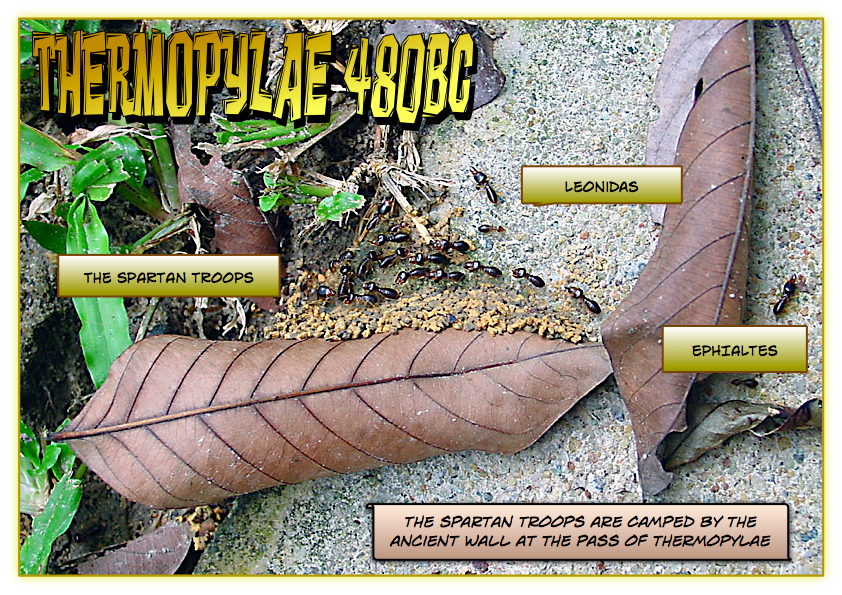
This is an ancient aerial photograph taken just before the final stages of the historic Battle of Thermopylae between the Greeks and the Persians in 480BC. The image was taken by Anna Chronism. The Greek forces were courageously led by Leonidas. The troops are camped by one of the ancient walls of the pass. To the right the traitor Ephialtes can be seen.

How was this post created? The original photograph was taken using a digital camera. Mt Faber, Singapore, 2003. The ants were building a wall of sorts prior to a storm on a step on a path. Were they intending to funnel water towards or away from their nest I wonder? Why were they building a wall? Was the impending storm their version of an invading Persian force? I imported the photograph into Comic Life. The cartoon elements were added. I exported the project as an image. Opened it in Photoshop Elements and saved the image for the web. Large and small.

Google Earth discoveries
November 23rd, 2008

Google Earth and its browser based cousin Google Maps fascinate. This morning I read that a possible meteorite crater has been discovered in western New South Wales. The report in the Sydney Morning Herald tells the story of opal miner Mike Fry and how he spotted the crater via Google Earth. Mr Fry had been using Google Earth to explore terrain for possible opal mining sites. The site requires further geological investigation to confirm it is the result of an meteorite impact. The western rim of the site is visible. The eastern rim has been significantly eroded and is no longer visible.


View Larger Map

Earlier this year another potential impact crater was discovered in Western Australia by Dr Arthur Hickman, a government geologist with the Geological Survey of Western Australia.


View Larger Map

If you are interested in similar discoveries and meteorite craters around the globe this Google Earth Hacks site, Craters [scroll down], and this Google Maps site, Meteor Craters may interest you.

It fascinates that both of these geological ‘discoveries’ were made whilst seated in front of a computer display.

Have you ever made a ‘discovery’ while exploring Google Earth or Google Maps. Some time back I was exploring some of the towns where my wife and I had lived while we were living in Singapore. To my surprise I ‘discovered’ that a group of trees that were located in a park that was adjacent to our estate spelt out the name of the town, Pasir Ris. We had walked through and around the park many times yet we never realised that the trees had been so planted.


View Larger Map

In the classroom I like to use Google Earth to support the teaching of history. It is particularly useful when teaching students the history of the Persian Wars. Sites for battles such as Marathon, Salamis, Thermopylae and Artemisium are all accessible. Of course the terrain and coastlines have altered to some extent yet the maps provide an invaluable viusal for the students and it makes the events all the more tangible.


View Larger Map

Battle of Marathon site. Athenian soldiers are buried in this mound.


View Larger Map

Both the Battle of Thermopylae and the naval battle of Artemisium were fought in this region.


View Larger Map

The Battle of Salamis was fought in the narrows between the island of Salamis and the coastline of ancient Attica

So, have you made any “discoveries” using Google Earth? What do you think are some of the more interesting locations visible via Google Earth? How do you use Google Earth in the classroom?

Teach the past or teach the future?
November 17th, 2008

Presently watching a documentary on television entitled “Where’s My Robot?“. Will not go into too much detail. Essentially the presenter went on a quest around the world looking for the robot that he had wanted as a child. Robots of varying capabilities in laboratories around the world were investigated. Researchers still have a long way to go. I wonder if this area of research is useful. Robots that can function in hazardous environments will be practical. Yet I wonder, are we spending money in the right places?

Given the challenges that the human race face with global climate change, for example, I wonder if I should change tack and begin teaching students about the past, the present and also the future. As a child I was so looking forward to the future. Well, the future has arrived and it has not matched my youthful expectations.

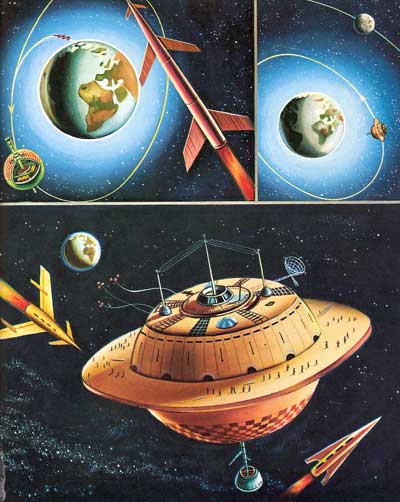
Growing up I had an interest in astronomy, space exploration and the future. I enjoyed reading books that provided glimpses into the future. When I turned 10 my father gave me a book entitled “Our World In Space and Time“. It was published in 1959. I have scanned a couple of images from the book in order to illustrate my thoughts. The book was essentially an overview of the the planet earth, its place in the universe and mankind. It was anglo-centric and written with an “imperial” view of the globe and its residents.

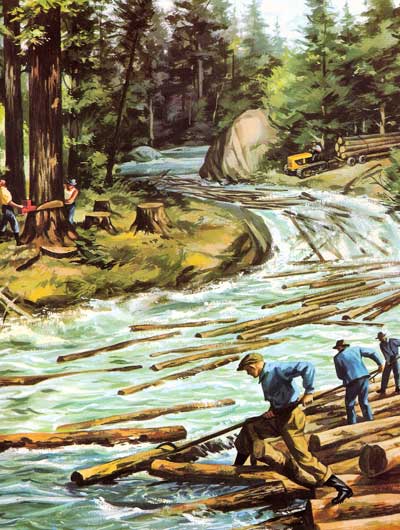
The overall impression it gave of the future was optimistic. There was no real hint that the resources of the planet were finite. In fact one of the chapters was entitled, “Forests that cover a quarter of the earth”. The chapter mentions that although there is a timber shortage in Europe and that “western Europe still needs more timber than it can easily come by.” Timber could be easily sourced from elsewhere. The image below faced the chapter. As you can see it shows forest clearing. It is depicted as a manly and exciting adventure.

Cut them down boys. Plenty more elsewhere.

The United Nations reports that about half of the world’s forests had disappeared and that most of that loss occurred during the three decades leading up to 1997. Afforestation projects are reversing the trends in some areas but it is not enough. ”Deforestation, mainly due to conversion of forests to agricultural land, continues at an alarmingly high rate – some 13 million hectares per year.” [Global Forest Resources Assessment 2005].

I live in Australia. It has the world’s fifth highest ecological footprint in the world. We are one of the greediest nations on the planet per capita. Shame. We need to do something.

The same book provided an optimistic view of space exploration as well. That dream has certainly not come to pass. The book and myself envisioned the 21st century with significant orbiting space stations, regular manned trips to the moon, bases on the moon, explorers on Mars and manned journeys making their way to the outer reaches of the solar system. Admittedly the text book was published in 1959 and Yuri Gagarin had not made the first manned space flight. But the vision seemed so possible.

The world in 2000

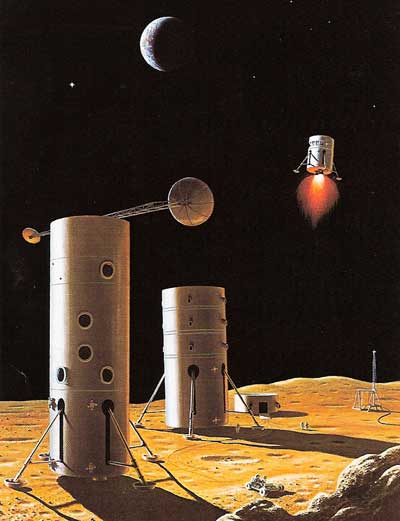
In 1973 I bought a book entitled Challenge of the Stars. It was published in 1972. It set out a series of predictions regarding the exploration of space by mankind. One of them was the establishment of a base on the moon by the 1990s. The illustration below sets out their ideas for life on the moon about 1990. It all seemed so easy back in 1973.

Moonbase 1990

I watched Stanley Kubrick’s 2001 A Space Odyssey as well during the evening. It presented a magnificent view of space travel in 2001 with regular space flights by Pan American Airways, massive space stations (that resembled a five-star hotel within), a moon shuttle, large bases on the moon, inter-planetary travel and so on. It was a grand vision. In 1968 it all seemed to be within our grasp. It seemed that all of that could be achieved. [I am not advocating that the human race attempt to achieve these goals now. More important matters are pressing.]

What has happened? The Clavius moon base illustrated in 2001 A Space Odyssey could not even be built on the planet earth in 2008 let alone on the moon. This planet is too busy building massive shopping centres while others starve. Nothing shits me more than seeing news reports about food eating contests, world record hot-dog consumption attempts and the like. I think that is obscene, particularly when one is likely to see images of starving or poverty stricken children during the same news bulletin. What is wrong with the human race?

In recent weeks wealthy nations around the world have raised nearly $USD5,000 billion to fight the global financial crisis. I am not an economist but one wonders if the planet’s economy was better managed in the first place surely that $USD5,000 billion could have been put to use preventing some of the woes that face us in the 21st century? Where did that money come from?

Governments around the world are tightening their budgets and going into deficit as well. Will they also reduce their proposed budget allocations originally designed to combat global climate change? Where do all of those promises stand now?

Imagine if governments no longer had to include the military in their budgets? The money could be spent on cleaning up the planet and feeding people. Of course, if that was to happen there would be military coups on every continent. The military would not allow it to happen.

There are times when I feel guilty. I have this laptop, a digital camera, a TV, etc. What is my ecological footprint?

The optimistic vision of the 21st century that I grew up with as a child is not coming to pass. The 21st century is beset with famine, poverty, climate change and a growing chasm between the rich and the poor.

I feel that we should be teaching students a range of values where materialism is not paramount. Community, resilience, sharing and giving. Positive values for the future. [I hope I do not sound like a politician. It sounds like something Kevin Rudd would say.] Yes, we share by example in our schools yet I feel that a more substantial slice of the curriculum should be devoted to teaching our students and ourselves how to really live on this planet.

It is the only planet that we have and given that by 2050 mankind will require the resources of 2 or 3 similar planets to satisfy the needs of the human race one wonders what will be left for the children of our current crop of students? Presently it is taking the planet 1.2 years to regenerate what is taken by mankind in a single year.

We need a new subject. It’s focus should be on the future. Not sure what to name the subject. But we need it. Maths, English, Music, History, Art, Science, Geography, and… Life.

Addedndum. I was exploring the ABC web site and discovered this interesting clip on their new Fora site. I am yet to watch all of it however it fits in with my thoughts here to some extent. The video consists of a debate between Harvard historian Niall Ferguson and futurist Peter Schwartz about which of the two disciplines is the better: Historian or Futurist?