|
|
|
Thoughts on teaching, technology, learning and life in an era of change. |
Archive for the ‘
History ’ Category
Clearing the decks and my back up of the Internet
January 20th, 2008
During the last few weeks Shao Ping and I have been re-organising our home. Following that downpour in December we decided that it was not such a good idea to have so much stuff downstairs. Our neighbour Dale who helped us to quickly move a lot of stuff upstairs agreed. We had created a rather nice study downstairs where we had our books, records, CDs and files. It was a nice place to escape. There was a sofa and a good desk.
But when that water started flowing in and we had to start shifting all the stuff closest to the floor upstairs it was essentially a pain. Now, we really do not want to go through that again so the books are coming upstairs. Maybe that downpour will not happen again. Maybe it will. Given climate change I am not willing to take that risk. I am yet to sort out the records. I am going to sell some on eBay. Many of them are bootlegs by David Bowie.
Yesterday I went through boxes of old files. I even found stuff going back to my days in the ANZ bank as a young bloke. My training assignments, notebooks and guides were all there. I ended up in the audit department and that was quite enjoyable as I was able to travel far and wide as myself and other auditors inspected groups of branches in diverse regions. I would find myself in one horse towns that normally I would not get the chance to visit.
I thought I had cleared out most of that material before our move to Singapore years ago but there it was. I spent all of yesterday going through the files and most of them went into our paper recycling bin. Even old assignments from university, and paper work from my time at the Interactive Multimedia Learning Laboratory at the University of Wollongong. Time to let go. I kept a few files that were either typical or special but that was it. About 6 packing boxes of stuff was reduced to a small box. The rest will be recycled. I still have two more filing cabinets to go. Some of the old newspapers and historical documents I will take to school.
At one stage I was employed by the university to train at least two teachers from every school in the region how to use the Internet. The trained teachers would be the Internet Contact Persons for that school. Every Tuesday and Thursday a group of teachers would come to the university and I would teach them how to use Netscape, Alta Vista, gopher searches, etc and the various ways one could go ‘back’.
Now, you may find this difficult to believe but I always carried a back up of the Internet with me on a number of floppy discs when my training took me to sites other than the university. I had used the software WebWhacker to completely download some web sites including Volcano World, The Nine Planets and a couple of others. I copied the folders to a set of floppy discs. Of course I could not do that today as these web sites have increased dramatically in size. Back in 1996 and 1997 it was possible.
I was conducting a training session at the University of Wollongong’s Shoalhaven campus at Berry on the south coast of NSW. We were using some Windows PCs running Windows 3.1 if I remember correctly. Might have been Windows 95 but I doubt it. There was a great storm and a lightning strike broke our connection with the Internet.
We decided to have a tea break and I placed the contents of the floppy discs on the server. The participants copied those folders to the computers and they simply clicked on the index.htm file for each web site’s folder to explore that web site. As a result they could learn how to use the Netscape browser. They could learn all of the buttons and most of the menu items. They could still learn how to download images and text. Just about the only thing they could not do was conduct a search.
Later that day the connection to the Internet was restored and the participants could learn about searching the Internet using Alta Vista, WebCrawler, Infoseek and others. I always enjoyed showing the teachers how to filter and refine the Internet searches. Another neat trick was showing them the power of exploring directories by altering the url of a site. The workshops were always enjoyable. The only time I was reasonably distracted was when one participant insisted on using the mouse “upside down”. When they rolled the mouse towards themselves the cursor went up the screen and vice versa.
I found some old publications from back then. Later today I will scan a couple of them online and write a quick blog. I hope you will be amused, enlightened and perhaps a little intrigued.
I would love to read some of your stories from the early days of the Internet. Ten years ago is really not that distant but in terms of the Internet it seems to be ages ago.
This afternoon, my sister’s husband Kieran will be coming around to help us shift the bookcases upstairs. Then we shall all retire to the pool in our backyard and later a barbecue. Isn’t life good?
Posted in
History, Illawarra, Life, Teaching, Technology, Travel |
2 Comments »

Immigration to Australia ~ resources for students of history
January 17th, 2008
During the course of Year Ten my students study a Stage 5 unit of history focused upon Immigration (NSW BOS Syllabus). One of the very first questions that I ask the students is “Which country do your ancestors hail from?” The students share their origins and there is a mixture of surprise and recognition as their various backgrounds are revealed. My own background is a mix of Irish and English heritage. It is not unusual for students in my class to have European, South American and Asian backgrounds. Some countries of origin predominate more than others within our school. Our region saw a great deal of immigration, particularly from Europe, after the Second World War.
There are some excellent resources on the Internet that I share with the students. One in particular is a web site established by the Migration Heritage Centre. Words almost fail me on this site. There is a wealth of primary historical source material. There are documents, photographs, community newspapers, video interviews and oral history reports. The site is well designed and the quality of the media is excellent. The content is relevant, rich and and varied. Anyone would enjoy exploring this site. There are dedicated stories within the site and I shall briefly look at some of these stories below.
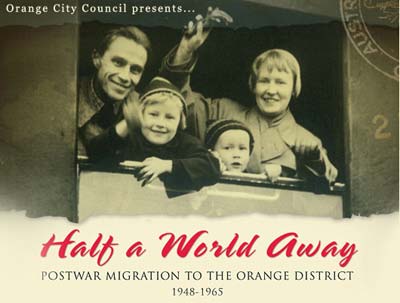
The first, Half A World Away, looks at post war migration to a country town in NSW called Orange. It is located across the Blue Mountains, several hours west of Sydney by car. For migrants from Europe the country town of Orange would have been a whole new universe. A wonderful town yet so different to Europe. There are stories from more than 20 different families. Some of the topics covered include Europe After The War, Journey To The End Of The Earth, Jobs For Everyone and a Time To Relax. The stories and photographs are captivating and intriguing. Perhaps some of your relatives live there now?
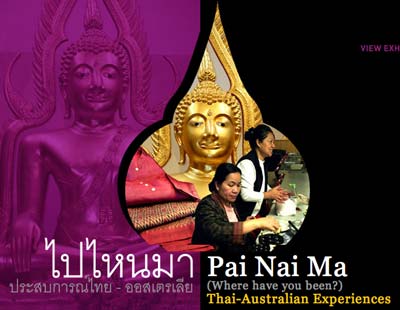
Another story, Pai Nai Ma (Where Have You been?) deals with the expereinces of Thai migrants to Australia. One of the first Thais I ever met was Miss Suwana at Holy Cross College, Bellambi back in 1981. She taught Thai, French and German as well as having an excellent command of the English language. Thai immigration to Australia stretches back to the 1860s however after 1901 it slowed with the introduction of the most distasteful policy in Australia’s history, the White Australia Policy. This abhorrent issue is dealt with in Pai Nai Ma. This section looks at Thai brides, early Thai migration and The Colombo Plan among other topics. (This section is difficult to read as there is little contrast between the font and the background).
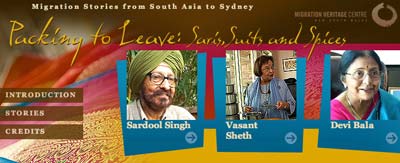
A third story is Packing To Leave ~ Saris, Suits and Spices. This section looks at migrants to Australia from South Asia, in particular the sub-continent. They originate from India, Pakistan, Sri Lanka and Bangladesh. There are 8 video accounts that describe their experiences including the shock of the new, homesickness and the feelings of their children ~ quite often the only non-white kids in an entire school. The accounts are moving and intriguing. This material is inspiring for the students and acts as a launch pad for their own audio and video projects.
Now, I ask my readers out there, anywhere, any country, any journey… do you have any immigration stories to share with others, including my students? I would feel happy to read your own stories, those of your ancestors or friends. Please add your thoughts below.
Posted in
History, Teaching, Technology |
2 Comments »
Australians at war ~ history resources for students
January 14th, 2008
Australians at War and Fifty Australians are two sites that I share with my students when teaching the Stage 5 Australian History course in NSW. The sites are suitable for all students. They are particularly relevant to my students in Years 9 and 10 History when we explore the involvement of Australians in the various international conflicts that took place during the twentieth century.
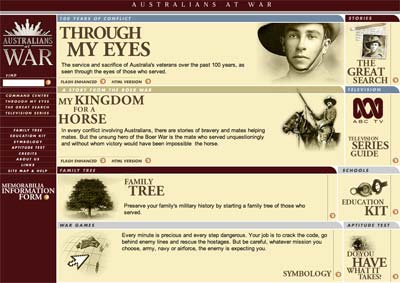
Australians at War was created in support of an Australian documentary series that aired back in 2001 however the site has a life of its own. The richest area of the web site are the numerous video and audio recordings of the soldiers, nurses and civilians that experienced the various conflicts. There are also letters, documents and transcripts to support the embedded media. These primary sources provide a wealth of original material for students and teachers.
The web site also features pdf based resources for teachers, three games for students, an aptitude test and a page where you can construct your family’s war history. I was hoping that the family trees of other visitors to the site would be available to view however they are not.
Each component is available in a flash or html version. Some of the Quicktime media was not available however one can simply select the Windows Media Format material in that case.
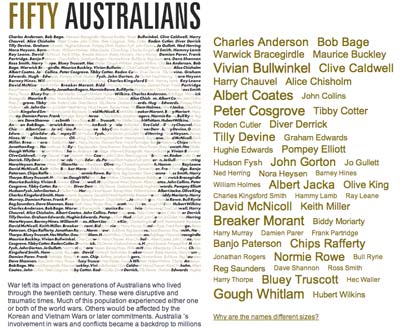
Fifty Australians is simply that. It provides biographies of fifty quite diverse Australians and how various conflicts ranging from the Great War through to the Vietnam War and beyond affected their lives. The individuals include ordinary men and women, politicians, rock stars and even rogues.
The web site has an interactive tag cloud that features the names of all fifty individuals. The font size of their name within the tag cloud reflects the number of visits to their page. Each biography is well written and features photographs and links to related resources at other web sites.
I have added links to both of these sites to the pages about my father’s experiences as a Prisoner of War and my pages for Year Nine History and Year Ten History.
Posted in
History, Technology |
Comments Off
The Perfect Corpse ~ just the thing for students of history
January 5th, 2008
One of the topics that I quite enjoy teaching in Year 11 Ancient History is Preserved Human Remains. The Year 11 students have just completed their School Certificate, not unlike the ‘O’ levels in the United Kingdom and they are preparing for their matriculation year, known here in NSW as the Higher School Certificate.
It is during Year 11 that we share with the students the skills of history. They discover how to interpret historical sources, gather together evidence, formulate convincing historical arguments and exhibit an empathy with the past.The Preserved Human Remains topic is an investigation into bog bodies, mummies and famous discoveries such as the Iceman.
During the course of the study students explore the following topics.
- Lindow Man, Grauballe Man, Windeby Girl, Tollund Man – places of discovery, dating of finds
- Events surrounding discovery of the bodies: preservation of the bodies in the peat bogs, possible causes of death, various hypotheses based on forensic evidence and other sources
- Reconstructing the lifestyle of these individuals: physical appearance, clothing, evidence of the environment; possible cause of death; associated rituals
- Comparison with other finds of a similar nature: Ice Man, mummified Scythians, Inuit boy, Peruvian mummies, Egyptian examples
- Religious beliefs and customs associated with burial practices of this nature
- Role of science and written sources in reconstructing the past.

There are a number of web sites that deal specifically with bog bodies and the Iceman. One in particular is quite interesting. The Perfect Corpse. This site was created to support a documentary that was shown on the PBS Network in the USA. This web site includes specific sections that include:

There is also a transcript of the documentary and a guide for teachers. Each section features excellent photographs and interactive components.

The site is not designed for students engaging in pre-matriculation studies however it is suited for Year 11 students to gain an insight into a variety of preserved bodies from around the globe and from a range of historical eras. The site is easy to navigate, well written and nicely illustrated. The site is also included among a set of links for my students that are focused on the study of Ancient History.
Posted in
History, Teaching, Technology |
Comments Off
The Petrov Affair ~ Australia’s Cold War Flashpoint
January 2nd, 2008
Australia never experienced anything at all remotely resembling the Cuban Missile Crisis or McCarthyism but we did have the Petrov Affair.
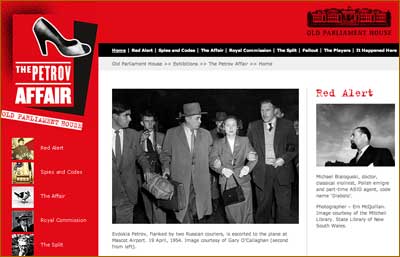
Back in April 1954 Australia had its very own Cold War drama when Vladimir Petrov defected while employed as a third secretary at the Soviet Embassy in Canberra, Australia’s capital city.
The episode became known as the Petrov Affair and it dominated the Australian political landscape and newspaper headlines. Australians were caught up in “stories of espionage and political conspiracy”.
As the Old Parliament House web site states, “The defection of the Petrovs came to be regarded by Western intelligence services as one of the most important of the Cold War era and it had a profound and lasting impact on the Australian political landscape, with the Labor Party Split a direct consequence of the events of 1954-1955.”
The Old Parliament House (now known as the Museum of Australian Democracy) has an exhibit commemorating the event and in support they have created a web site rich with resources suitable for students of Cold War history near and far. There is also a web quest that students can explore. The resources are particularly useful for students of Australian history at Stage 5 of their schooling in NSW. There is a wealth of documents, photographs, media files and links to investigate. There is also a Wikipedia article regarding the event.
Posted in
History, Politics, Teaching, Technology |
15 Comments »
|

|
|
|