Thoughts on teaching, technology, learning and life in an era of change.

Archive for the ‘ History ’ Category

Kokoda Track Memorial Walkway
March 17th, 2008

Last week a number of teachers and students from the Albion Park ~ Oak Flats area of the Illawarra visited the Kokoda Track Memorial Walkway in Sydney. We were guest of the Albion Park RSL Sub Branch. The Returned and Services League of Australia (RSL) serves the interests of its members, veterans, the ex-service community and members of the Australian Defence Force.

The Kokoda Track Memorial Walkway is an interesting memorial. It remembers the bravery of the Australian troops who fought through appalling conditions and against superior enemy numbers in the Papua-New Guinea campaign of July 1942-January 1943. The Australians inflicted defeat on the Japanese Imperial Army with US support. The fighting took place along the Kokoda Track.


View Larger Map

The walkway consists of a series of stations along an 800 metre walk. Each station documents an event during the campaign. There is also a larger memorial complete with a water feature and five startling images from the campaign that have been sandblasted into the walls of the memorial.

There were guides from the RSL that took small groups of three or so teachers and students from station to station. Our guides were Charlie and Lloyd. Both men had fought in the campaign and were now in their eighties. The oldest guide was 91 years of age. It was both amazing and moving to meet some of the men that were in the historical photographs displayed at the memorial.

The day was most informative and despite the heat a good day was had by all. The RSL provided lunch for all of the teachers and students as well as providing coach transport to and from the venue. They were excellent hosts.

Looking towards the main memorial

Part of the main memorial

A section of the memorial walkway

One of the stations

A selection of the indivdual memorials at the Rose Garden

The walkway is supported with an excellent web site that provides additional detail and photographs for each of the stations on the walkway. There is also a selection of oral histories with both archival and recent recordings of the ‘diggers’ on the track.

The web site constitutes an excellent resource for teachers and students of both Australian history and the history of the Pacific campaigns during the Second World War. Students undertaking Stage 5 history in NSW would particularly find this site useful as they explore the role played by Australia during the Second World War.

Links:

Kokoda Track Memorial Walkway

The Kokoda Track at www.anzacday.org.au

The Kokoda Trail at www.diggerhistory.info

The Kokoda Track Campaign at wikipedia
Empathy in history
February 19th, 2008

One of the attitudinal skills that students need to pick up as part of the course in history is a knowledge and appreciation of empathy. A strategy that I have employed  is to exhibit some dramatic and iconic images from history including the Hindenburg tragedy, the 2004 Asian earthquake and tsunamiAustralian Ash Wednesday bushfires and the 1986 Challenger disaster. Still images and video are shown to the students.

The students are asked to comment and ask questions about the events and words that came up in the discussion include sympathy, shock, sadness and surprise. The students realise that the images are history. The text book has a dry old paragraph about empathy. They appreciate that history is about people. The students seemingly gain a grasp that history is about people and that people in the past have feelings, views, opinions and emotions as we do today.

Watching the video downloaded from YouTube and the images gathered via Picture Australia and Google search provided the visual resources that I needed for the lesson. The Internet proved very resourceful indeed.

I used Tooble on the Mac to download the videos from YouTube. Following download the flv files were converted on the fly into mp4 files and exported to iTunes.

Can anyone recommend a similar application for downloading and converting YouTube style embedded video files on the Windows XP or Vista platform?

WW1 ~ The experiences of an English soldier
February 10th, 2008

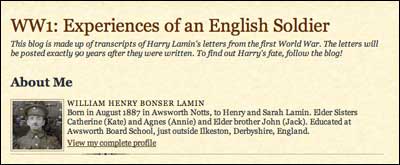
This morning, one of my colleagues, Flora, alerted me to this excellent historical blog. It is the WW1 letters of William Henry Lamin. As the blog author indicates the blog itself is made up of transcripts of Harry Lamin’s letters from the first World War. The letters will be posted exactly 90 years after they were written. This is not unlike the famous Pepys Diary I have blogged about elsewhere.

The details and comments provide minute detail regarding the life of an English soldier during the Great War 1914-1918. There are two related blogs that support the blog containing Harry’s letters. One blog is concerned with readers’ comments and the other is the official War Diary of the 9th Battalion of York and Lancaster Regiment.

These three blogs comprise an excellent resource of primary source evidence for students of history anywhere. I shall certainly be sharing these blogs with my Year Nine students and my other history teaching colleagues.

The Black Death In Sydney 1900
February 9th, 2008

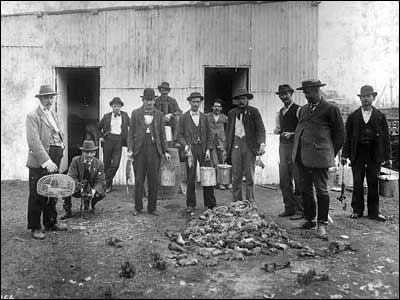
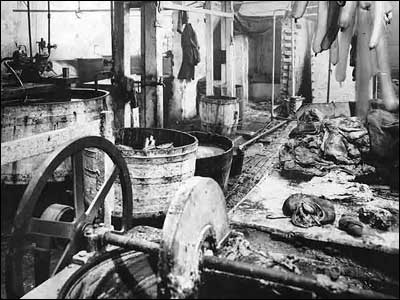
Many of you have probably heard of the Black Death or the bubonic plague. I must note that the Black Death may have not been caused by bubonic plague but back to the point. Sydney, Australia, experienced the bubonic plague during the early years of the twentieth century and the State Records Authority of NSW has created a nice gallery of photographs taken during the time. I have included a photograph of some professional ratcatchers with their haul as well as a photograph of a butcher’s shop.

The gallery, Purging Pestilence – The Bubonic Plague, features 20 excellent photographs as well as an overview of the outbreak. There are also links to government records and files regarding the outbreak. Additional photographs taken during the time can be found with this search of the State records.

This material would be useful as primary and secondary sources for teachers working with Year Nine students in NSW who are covering the history of Australia during the period 1900 to 1914. I shared all of the photographs, via a quick slideshow and an overhead projector, with my students in Year Nine yesterday, across three separate classes.

The butcher’s shop below and this photograph resulted in expressions of dismay and disgust as well as delight. That’s the way a classroom should be. Weave the photographs into a story and let the history stir their emotions. 

The gallery is part of a series of digital galleries that feature stories regarding tragic shipwreckscriminal history, the bushranger Ned Kelly and famous murder cases just to name a few.

Archaeological technique ~ a couple of good web sites
February 3rd, 2008

During the Year Eleven Preliminary Course in Ancient History (NSW BOS Syllabus) the students are given an introduction to archaeological technique. Topics include aerial photography, crop marks, dendrochronology, underwater archaeology, managing a dig, carbon dating and so on. There are a number of useful web sites available for students to access. Two sites include Past Perfect and Background On Archaeological Methods. Each site is quite different but useful in its own way.

Past Perfect examines the archaeology of Durham and Northumberland with photographs of digs, artefacts and the region. It incorporates rendered and VRML reconstructions of the sites. It provides valuable insights into the lives of the original inhabitantsbuilding methods and climate change. In addition Past Perfect has a section dedicated to the techniques of the archaeologist. There is a wealth of material to explore within the site. In terms of classroom activities students could explore the site as groups and publish their own findings on nominated sections of the site.

The site, Background On Archaeological Methods is a straightforward site that sets out in plain English the key components of archaeology. It can act as a quick introduction to archaeology for students and the general public alike. Topics covered include site grids, dating, stratigraphy, artefact recovery and record keeping. 

Additional web sites focused upon the techniques of the archaeologist can be found linked to from this dedicated web page.