Thoughts on teaching, technology, learning and life in an era of change.

Archive for the ‘ History ’ Category

Singapore ~ before & after
April 25th, 2008

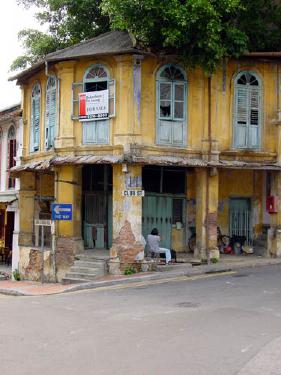
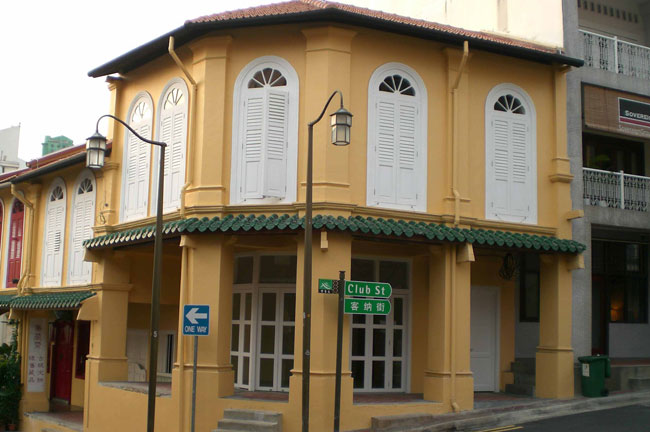
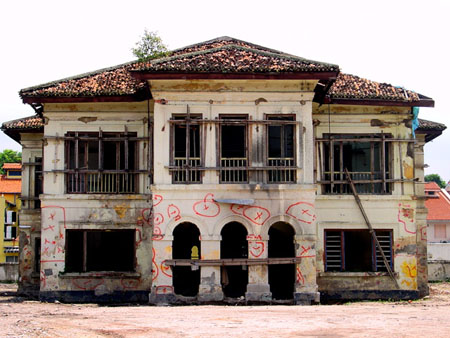
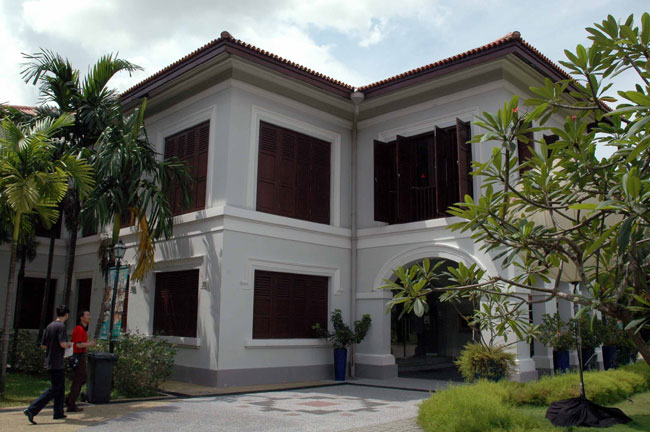
During the last couple of trips to Singapore I have managed to photograph a few places I had visited while I lived in Singapore and as a result a few before & after opportunities have presented themselves. Singapore is constantly changing, constantly.

Sometimes the past is preserved. At other times the past disappears.  Let me share three simple examples.

1. The corner of Club Street and Ann Siang Road

Before

Visit site: The Pasir Ris Mercury

After

Visit gallery.

2. Kampong Glam

Before

Visit gallery.

After

Visit gallery.

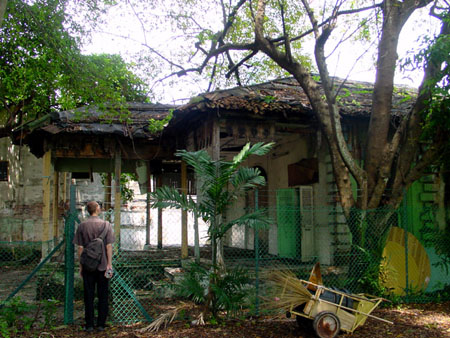
3. Sultan Gate ~ Abandoned property

Before

Visit gallery.

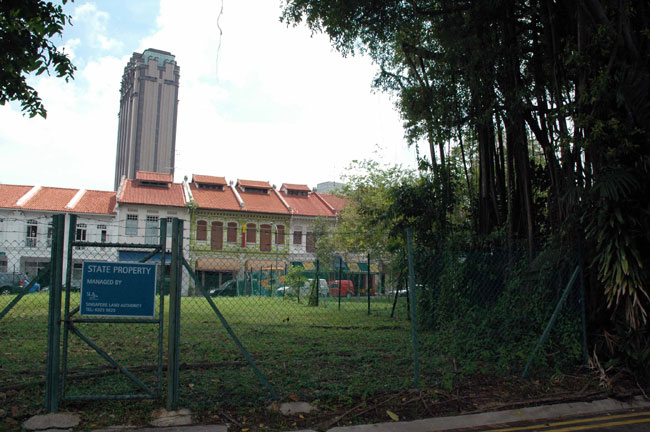
After

Visit gallery.

Egyptian archaeology with AERA
April 9th, 2008

Today, I literally stumbled upon the following web site, AERA ~ Ancient Egypt Research Associates. This is the official web site of AERA and as they point out on their home page it provides a window into the “work of Dr. Mark Lehner and the international team of the Giza Plateau Mapping Project”. It is a well designed site that is easy to navigate.

It features a rich array of textual and visual resources that would be ideal for any teacher and students interested in Egyptian archaeology and the rich history of ancient Egypt. There are links to four key areas of the web site: Projects, Specialists, Artifacts and Resources.

The projects cover such topics as the The Sphinx Project, Giza Plateau Mapping Project, The Lost City of The Pyramids and the How Old are the Pyramids. Each project is documented in excellent detail and well supported with photographs, maps and diagrams.

The specialist projects consider problems such as the feeding 20,000 workers and the significant role of stone tools in Egyptian society. The artifacts sections contains excellent photographs of related Egyptian antiquities and the resources provide links to publications and related sites on the Internet.

There are many primary and secondary source materials for students to explore. Teachers of the Preliminary Ancient History Course in NSW could take one of the projects and evolve it into a customised case study. Of course teachers of Stage 4 History in NSW could also take full advantage of this excellent web site when teaching the junior history course to Years 7 or 8. I have added a link to this site on my dedicated pages for Year 8 History, Year 11 Ancient History and Year 12 Ancient History.

—————-
Now playing: Philip Glass – From Egypt
via FoxyTunes

Historic Tale Construction Kit ~ The Bayeux Tapestry 1066
April 5th, 2008

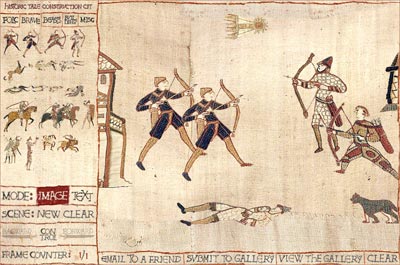
This morning I read about the Historic Tale Construction Kit in the Instructify blog. This web based application allows you to create a sequence of mediaeval events using images drawn from the Bayeux Tapestry. I believe that teachers of history that cover the middle ages would find this application very useful on a number of different levels.

Teachers and students could recreate scenes from the tapestry and add additional text blocks that annotate the scene.

Scenes from the tapestry could be reworked thus generating arguments and controversies for debate. This could be considered a mediaeval form of “airbrushing” and “photo-retouching”. Discussion based upon “What if?” scenarios could be started.

The application allows the user to drag and drop a variety of characters, animals, beasts, plants, buildings and boats on to the canvas. These objects alone could be used as standalone focal points for analysis and discussion. You can also add authentic looking text to the canvas. They have even included Halley’s Comet which made an appearance in 1066 and was included on the original tapestry. You can create a sequence of scenes and advance from one to the next.

The user generated images can be emailed to a friend or sent to a gallery (although I could not get this to work). Savvy computer users could take a screen capture of the image, save it as a jpeg and then import it into a VoiceThread. Students could then add their own commentary to the image. They could also create an imaginative oral history based upon the characters in the mediaeval scene. The image in this post is a screen capture. Captured images could also be embedded in presentations, blogs and so on. There are opportunities for learning, debate, humour and fun. This is a captivating application.

It was a little buggy at times. I suspect that you can only drag a maximum of 9 or so objects onto the tapestry window. After that previously placed elements disappear. At times it appeared to freeze when you dragged an element on to the editing window from the palette at left. When embedding text you cannot place the cursor i-beam at the point you wish to re-edit. You have to use the delete or back-space key to return to the editing point. I was unable to publish to the gallery. My first attempt at using this online application can be found at this post.

I know that teachers of the Stage 4 History syllabus in NSW would find this a handy tool to use when teaching students about the society and people of the Middle Ages during Year 8 of their schooling. Students studying the Battle of Hastings will find it particularly useful.

As an aside I conducted a quick search for related sites and two of the more interesting were EuroDocs: Britain 1066-1485 which is a treasure trove of primary source material and The Bayeux Tapestry which provides a Quicktime VR panoramic view of the Bayeux Tapestry.

Links

Historic Tale Construction Kit
Medieval Sourcebook: William of Malmesbury, d. 1143?: The Battle of Hastings, 1066
Anglo-Saxon Sourcebook: The Battle of Hastings
The Battle of Hastings: A brief tour by Dr Deborah Vess
The Battle of Hastings according to Orderic Vitalis
J.P.Sommerville: The Battle of Hastings
EuroDocs: Britain 1066-1485
Britain’s Bayeux Tapestry at the University of Reading
Official site of the Bayeux Tapestry (French)
The Bayeux Tapestry
The Bayeux Tapestry ~ QuicktimeVR panorama
Wikipedia: Bayeux Tapestry and Battle of Hastings

—————-
Now playing: XTC – Senses Working Overtime
via FoxyTunes

Diigo at the Battle of Hastings ~ 1066AD
April 5th, 2008

I was conducting a little research on the Battle of Hastings by closely examining the Bayeux Tapestry. It is 270 metres in length and 50 centimetres in height. It is an amazing document and truly one of the great primary sources of history.

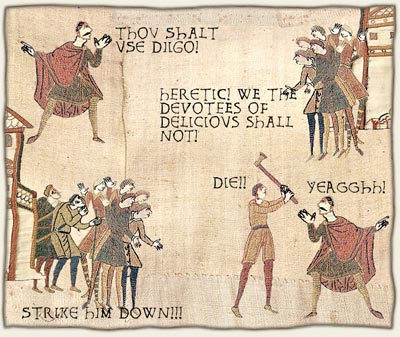
Can you imagine my shock when I found a reference to the term diigo! I captured the scene and I reproduce it below for your enlightenment.

The image was created with Historical Tale Construction Kit. Via Instructify. Neat, eh? I shall blog a little more on this online app in the future.

—————-
Now playing: David Bowie – Kooks
via FoxyTunes

World’s oldest recorded sound
March 29th, 2008

This morning I read an article in the Sydney Morning Herald about the world’s oldest recorded sound. The recording was made by Édouard-Léon Scott de Martinville on a phonautograph. The audio recording predates Edison’s sound recordings by a couple of decades. The recording is available from the the First Sound site.


The world’s oldest recorded sound

The entire recording is ten seconds long and features a Parisian singer giving a rendition of the folk song “Au Clair de la Lune”. The recording was made on a phonautograph, a device that was created to record sounds visually. It was not designed to play them back. A group of scientists at the Lawrence Berkeley National Laboratory in Berkeley, California devised a method to decode the paper based transcription to audio.
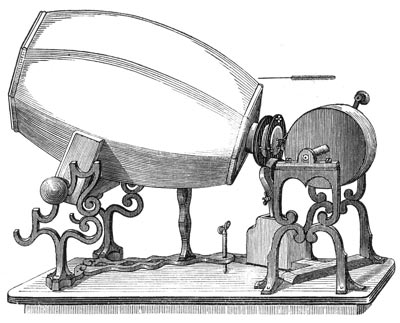
The 1859 model of Scott’s phonautograph. Source: Franz Josef Pisko,
Die neuere Apparate der Akustik
(Vienna, 1865). Image courtesy of David
Giovanni and First Sounds.

Detail of an 1859 phonautogram made by Scott and included in his patent paperwork, preserved at the Institut National de la Propriété Industrielle (INPI),
the French patent office. Image courtesy of David Giovanni and First Sounds.

David Giovanni gave permission for the reproduction of the images on this page. His own web site is well worth exploring. David Giovanni has been involved in the discovery and publication of old recordings. One of his releases, Lost Sounds: Blacks and the Birth of the Recording Industry, 1891-1922, even won a Grammy Award.
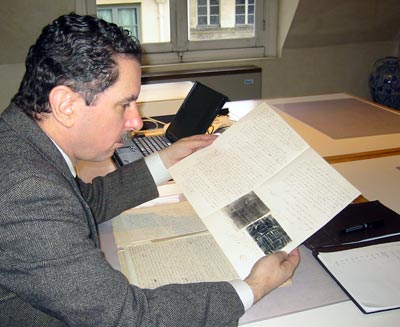
David Giovannoni inspects Scott’s first two experimental sound recordings,
made in 1853 or 1854, in the archives of the Académie des Sciences
of the Institut de France, where they were deposited in 1857.
Photo by Isabelle Trocheris. Image courtesy of David Giovanni and First Sounds

.
I have always had a fascination with audio. I used to enjoy taking bootleg recordings of artists like Bowie, Led Zeppelin and others and then attempting to improve the sound quality using tools like graphic equalisers and a DBX 117 dynamic range enhancer. I was once a guest editor of Crosstalk, the journal of the Australian Tape Recording Society way back in 1980, I think.

Vaguely related note: If you are interested in old 78RPM records I highly recommend that you check out Joe Bussard’s Fontone Records site. He was born in 1936 and is a classic digital native. Check out his MySpace profile for his take on rap music and rock ‘n’ roll.

Links:

Wikipedia: Édouard-Léon Scott de Martinville
First Sound.org
David Giovanni’s web site.
New York Times. Researchers Play Tune Recorded Before Edison
Sydney Morning Herald. Listen up: world’s oldest recording gets airplay
Archeophone Records
Fonotone Records
Joe Bussard’s MySpace page