Thoughts on teaching, technology, learning and life in an era of change.

Archive for the ‘ Teaching ’ Category

Immigration to Australia ~ resources for students of history
January 17th, 2008

During the course of Year Ten my students study a Stage 5 unit of history focused upon Immigration (NSW BOS Syllabus). One of the very first questions that I ask the students is “Which country do your ancestors hail from?” The students share their origins and there is a mixture of surprise and recognition as their various backgrounds are revealed. My own background is a mix of Irish and English heritage. It is not unusual for students in my class to have European, South American and Asian backgrounds. Some countries of origin predominate more than others within our school. Our region saw a great deal of immigration, particularly from Europe, after the Second World War.
There are some excellent resources on the Internet that I share with the students. One in particular is a web site established by the Migration Heritage Centre. Words almost fail me on this site. There is a wealth of primary historical source material. There are documents, photographs, community newspapers, video interviews and oral history reports. The site is well designed and the quality of the media is excellent. The content is relevant, rich and and varied. Anyone would enjoy exploring this site. There are dedicated stories within the site and I shall briefly look at some of these stories below.
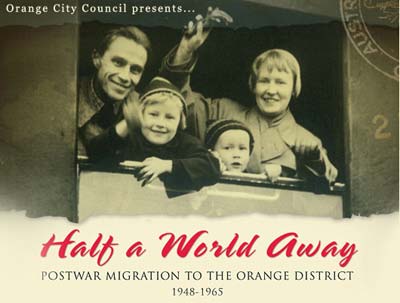
The first, Half A World Away, looks at post war migration to a country town in NSW called Orange. It is located across the Blue Mountains, several hours west of Sydney by car. For migrants from Europe the country town of Orange would have been a whole new universe. A wonderful town yet so different to Europe. There are stories from  more than 20 different families. Some of the topics covered include Europe After The War, Journey To The End Of The Earth, Jobs For Everyone and a Time To Relax. The stories and photographs are captivating and intriguing. Perhaps some of your relatives live there now?
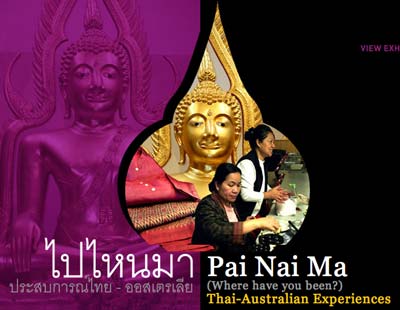
Another story, Pai Nai Ma (Where Have You been?) deals with the expereinces of Thai migrants to Australia. One of the first Thais I ever met was Miss Suwana at Holy Cross College, Bellambi back in 1981. She taught Thai, French and German as well as having an excellent command of the English language. Thai immigration to Australia stretches back to the 1860s however after 1901 it slowed with the introduction of the most distasteful policy in Australia’s history, the White Australia Policy. This abhorrent issue is dealt with in Pai Nai Ma. This section looks at Thai brides, early Thai migration and The Colombo Plan among other topics. (This section is difficult to read as there is little contrast between the font and the background).
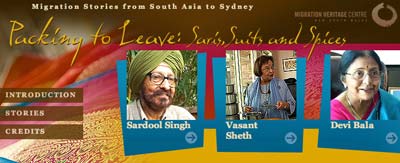
A third story is Packing To Leave ~ Saris, Suits and Spices.  This section looks at migrants to Australia from South Asia, in particular the sub-continent. They originate from India, Pakistan, Sri Lanka and Bangladesh. There are 8 video accounts that describe their experiences including the shock of the new, homesickness and the feelings of their children ~ quite often the only non-white kids in an entire school. The accounts are moving and intriguing. This material is inspiring for the students and acts as a launch pad for their own audio and video projects.

Now, I ask my readers out there, anywhere, any country, any journey… do you have any immigration stories to share with others, including my students? I would feel happy to read your own stories, those of your ancestors or friends. Please add your thoughts below.


Social network sites in the classroom
January 17th, 2008

The Economist has set up a debate between Ewan McIntosh (National Adviser on Learning and Technology Futures for Learning and Teaching Scotland) and Michael Bugeja (Director of Greenlee School of Journalism and Communication, ISU). The debating topic ~ “Social Networking: does it bring positive change to education?”

Danah Boyd wrote an excellent post reflecting on the debate. Her thoughts mirror my feelings on social network sites and their place in education. I commented on her post as follows.

‘Danah – A post that emulates my own thinking. Facebook and MySpace are not tools that can be embedded into a teaching and learning curriculum. I personally cannot imagine incorporating Facebook or Myspace into a teaching programme.There are better strategies and tactics that one can use to achieve the desired learning outcomes. Blogs, wikis and Flickr – sure, they can be used to augment learning and provide opportunities for collaboration.

As I say at the beginning of all my workshops… as a teacher I have a ‘backpack’ of tools that I draw upon to teach and foster learning. What do I find when I reach into that ‘backpack’? Whiteboard markers, exams, rulers, field trips, debates, pens, text books, metaphor, discussions, pencils, storytelling, writing responses and… technology now and then. What do I mean by technology in this case? It could include the Internet, Word, blogs, wikis and others.

Facebook and MySpace have their place in the community. I simply cannot see either of these being written into one of my teaching programmes at this point in time. Yes, technology is not the universal cure and it is not the enemy. Technology is just another tool, a way, a thing. I wish I had written your post Danah. I often relate these ideas to other teachers. I think I should write more.’

Will Richardson, whose post alerted myself to Danah’s wrote some telling thoughts on the issue of Social Network Sites as well. Will writes that he finds tools such as Facebook to be redundant with reference to the other tools that he employs. I agree.

I gave Facebook a trial and frankly it did not impress me. The ‘games’, comparatison tests, super wall stuff and the rest of it just seemed to be so puerile and a complete waste of time. Do I really care that someone likes the same movies as myself? I ask, will that knowledge assist the planet in its rotation around the sun? No, it will not. There are more significant matters in life. As I posted on my own Facebook site I felt that it was not a great tool. I have not looked at it for a while now. I could not employ this tool in the classroom. It is a great vehicle for maintaining tabs on friends near and far but right now I could not see it incorporated into my teaching programme.

MySpace is simply not for my classroom or for me. I gave it a try to and in fact I am in the midst, albeit part time, of trying to code an elegant looking MySpace page. My dislike of MySpace is well documented elsewhere in this blog yet I am willing to see what I can do with it. I dislike MySpace for a number of reasons. I find the interface to be clunky and ugly. I also believe that people waste a great deal of valuable time with their use of this social network site. The same applies to Facebook. MySpace in my teaching programme? Not yet.

On social networking sites Danah wrote, “I have yet to hear a compelling argument for why social network sites (or networking ones) should be used in the classroom. Those tools are primarily about socializing, with media and information sharing there to prop up the socialization process (much status is gained from knowing about the cool new thing).” I agree.

It really does not require that much thinking. To me it is plain commonsense. Just because it is a “Web 2.0 tool” it does not mean one has to weave it into a teaching and learning programme. As far as I am concerned any attempt to employ MySpace or Facebook in the classroom would be like trying to bash a square peg into a round hole.

Web 2.0 for the Classroom Teacher
January 14th, 2008

Sue Summerford has created this one stop shop of Web 2.o resources for the classroom. Her Web 2.0 for the Classroom Teacher page provides links to a multitude of tools, blogs, collaboration examples and more.

A quick Google search on Sue located this article that Sue wrote for EdTech magazine on the need to focus on educational objectives when selecting technology tools for the classroom.

Are you reading these blogs? #2
January 13th, 2008

Back on January 1 this year I wrote a post “Are You Reading These Blogs?” Well, I have been catching up on the various blogs that I have subscribed to since my wife and I moved back into the home last Friday night. As I read through the week or so of posts I noted down about 70 things I would like to explore further this week.Well, all of those items will have to take a back seat. Once again I ask the question… Are you reading these blogs? Today I discovered two education blogs that I feel will benefit any educator that reads them.

The first is Kate 2.0. This blog is new. Kate Olson is a first year business education teacher in Wisconsin. Kate’s first post was on the 6th January and she has written excellent commentary on blogging, twitter and collaboration. Add Kate 2.0 to your reader.

Kate’s blog pointed me in the direction of  Transitioning To Web 2.0, a blog created by Janette Black. Janette’s blog is also worth checking out. Her post on how to use blogs to promote authentic learning in the classroom is legendary.

The Perfect Corpse ~ just the thing for students of history
January 5th, 2008

One of the topics that I quite enjoy teaching in Year 11 Ancient History is Preserved Human Remains. The Year 11 students have just completed their School Certificate, not unlike the ‘O’ levels in the United Kingdom and they are preparing for their matriculation year, known here in NSW as the Higher School Certificate.

It is during Year 11 that we share with the students the skills of history. They discover how to interpret historical sources, gather together evidence, formulate convincing historical arguments and exhibit an empathy with the past.The Preserved Human Remains topic is an investigation into bog bodies, mummies and famous discoveries such as the Iceman.

During the course of the study students explore the following topics.

  • Lindow Man, Grauballe Man, Windeby Girl, Tollund Man – places of discovery, dating of finds
  • Events surrounding discovery of the bodies: preservation of the bodies in the peat bogs, possible causes of death, various hypotheses based on forensic evidence and other sources
  • Reconstructing the lifestyle of these individuals: physical appearance, clothing, evidence of the environment; possible cause of death; associated rituals
  • Comparison with other finds of a similar nature: Ice Man, mummified Scythians, Inuit boy, Peruvian mummies, Egyptian examples
  • Religious beliefs and customs associated with burial practices of this nature
  • Role of science and written sources in reconstructing the past.

There are a number of web sites that deal specifically with bog bodies and the Iceman. One in particular is quite interesting. The Perfect Corpse. This site was created to support a documentary that was shown on the PBS Network in the USA. This web site includes specific sections that include:

There is also a transcript of the documentary and a guide for teachers. Each section features excellent photographs and interactive components.

The site is not designed for students engaging in pre-matriculation studies however it is suited for Year 11 students to gain an insight into a variety of preserved bodies from around the globe and from a range of historical eras. The site is easy to navigate, well written and nicely illustrated. The site is also included among a set of links for my students that are focused on the study of Ancient History.