Thoughts on teaching, technology, learning and life in an era of change.

Archive for the ‘ Technology ’ Category

Mr Winkle Wakes
March 24th, 2008

Mathew Needleman, author of the informative blog, Creating Lifelong Learners, created and posted this excellent video on YouTube the other day. It is well worth watching. The video elegantly portrays in a visual manner the essence of much of the writing in the world of educational blogging.

[kml_flashembed movie="http://www.youtube.com/v/lm1sCsl2MQY" width="425" height="350" wmode="transparent" /]

Update: Mathew has blogged about the video at this post.

Twitter surprise from Flocker
March 23rd, 2008

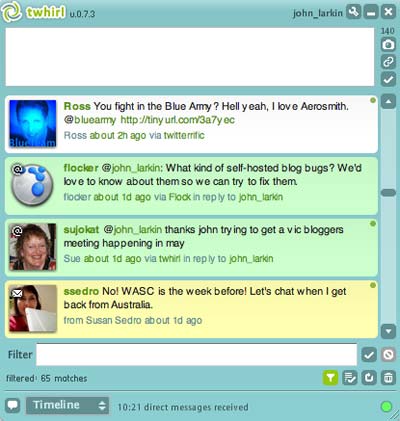
About a day or so ago I exchanged a couple of brief notes via Twitter with edublogger par excellence Clay Burrell regarding the Flock browser. I mentioned that I liked Flock but was disappointed that I could not post directly to my self- hosted WordPress blog. It has trouble recognising the api I think. Prior to that I could post directly to my old Blogger blog. It is a neat tool as you automatically gather the urls and images into the post via Flock’s excellent feature set.

Well, I was glancing through my tweets this morning and here is this tweet from the Flock team asking how can they help with my Flock problem. That is amazing. I wasn’t even following Flock.

Think about it. If I had commented on my Mac or something to do with Microsoft Office would I have received a tweet from those organisations? I replied and I now await their response.

Update: Monday 24th March. Flock replied to my twitter response and provided me with the email address of one of their staff members. Excellent service!

Christopher D. Sessums on Social Networks
March 22nd, 2008

Christopher D. Sessums has written on social networks and he has used the agora of the ancient Greeks as an analogy. He writes that the “various social and participatory applications available to us can serve… as a place where people can freely examine a wide range of ideas and ideals.”

I will not attempt to paraphrase all of Christopher’s post yet he asked a couple of questions that resonated with me. He writes:

“But the next step requires us to be reflective. The Internet and Web have afforded us an opportunity to re-examine and re-define our morals, our communities, our nations, and the globe. But will these conversations be limited to only a few? What mechanisms are in place to encourage and support a wide range of thought and activity?”

I have wondered about the conversations of late and the diversity of thought within the edublogosphere and at least within the blogs that I read there seems to be a sameness creeping into the environment. I articulated these thoughts a little further on Christopher’s blog. Something along these lines…

I feel that his two questions, as quoted above, are timely and they need to be asked. I have sensed of late that segments of the “edublogosphere” are dominated by a small coterie of seasoned bloggers who are followed by a dedicated core of disciples that hang off their every word. I think this is stifling original thought and creating a sameness in some edublogging arenas. The conversations are limited to a few yet cloned by many.

I have observed a number of new edubloggers join the networks of late and they soon become mirror images of the more seasoned or ‘vocal’ edubloggers. It is a pity. I feel that the twitter networks play a role in the establishment of this sameness.

“What sort of mechanisms can we set up to encourage creativity and diversity among edubloggers?” I agree that the world of education bloggers should be more like an agora with a highly varied range of discussions, debates, marketing of ideas and the ‘playing of games’ (as per an agora). The agora of ancient Athens was largely responsible for the creation of democracy, philosophy and western thought.

At the moment I fear that the edublogosphere is evolving into a collection of shopping malls populated with overly dominant voices that are differentatiated only in the way that they are branded. We do need more voices. Different voices.

Looking at Christopher’s blogroll I also think it is time I explored a few new voices and joined a few new networks.

Kokoda Track Memorial Walkway
March 17th, 2008

Last week a number of teachers and students from the Albion Park ~ Oak Flats area of the Illawarra visited the Kokoda Track Memorial Walkway in Sydney. We were guest of the Albion Park RSL Sub Branch. The Returned and Services League of Australia (RSL) serves the interests of its members, veterans, the ex-service community and members of the Australian Defence Force.

The Kokoda Track Memorial Walkway is an interesting memorial. It remembers the bravery of the Australian troops who fought through appalling conditions and against superior enemy numbers in the Papua-New Guinea campaign of July 1942-January 1943. The Australians inflicted defeat on the Japanese Imperial Army with US support. The fighting took place along the Kokoda Track.


View Larger Map

The walkway consists of a series of stations along an 800 metre walk. Each station documents an event during the campaign. There is also a larger memorial complete with a water feature and five startling images from the campaign that have been sandblasted into the walls of the memorial.

There were guides from the RSL that took small groups of three or so teachers and students from station to station. Our guides were Charlie and Lloyd. Both men had fought in the campaign and were now in their eighties. The oldest guide was 91 years of age. It was both amazing and moving to meet some of the men that were in the historical photographs displayed at the memorial.

The day was most informative and despite the heat a good day was had by all. The RSL provided lunch for all of the teachers and students as well as providing coach transport to and from the venue. They were excellent hosts.

Looking towards the main memorial

Part of the main memorial

A section of the memorial walkway

One of the stations

A selection of the indivdual memorials at the Rose Garden

The walkway is supported with an excellent web site that provides additional detail and photographs for each of the stations on the walkway. There is also a selection of oral histories with both archival and recent recordings of the ‘diggers’ on the track.

The web site constitutes an excellent resource for teachers and students of both Australian history and the history of the Pacific campaigns during the Second World War. Students undertaking Stage 5 history in NSW would particularly find this site useful as they explore the role played by Australia during the Second World War.

Links:

Kokoda Track Memorial Walkway

The Kokoda Track at www.anzacday.org.au

The Kokoda Trail at www.diggerhistory.info

The Kokoda Track Campaign at wikipedia

George Siemens on technology and pedagogy
March 16th, 2008

George Siemens, author of the Connectivism Blog, wrote a nice piece on pedagogy and technology today. He questions the fixation that some educators have with the role of pedagogy in using technology. I will not attempt to recreate his thoughts myself however I will embed a couple of quotes from his post…

Pedagogy should not even be a consideration during the planning stages of technology use. Harsh statement? Perhaps, but it’s a reality. Few Utopian situations exist where our decisions on how to teach can be based exclusively on pedagogy.

Let’s abandon the somewhat silly notion of pedagogy first and recognize that the choice of technology is driven by many contextual factors and therefore context is what we are evaluating and considering when we first start talking about possible technology to use. Then, after we have selected technology, we can start talking about pedagogy. Pedagogy is just not a practical starting point for deciding the technology we should use.

I thought I would take this opportunity to publish my comment to his post here as well. I attempted to articulate the unconscious (or semi-conscious?) process that I go through when I use technology as part of the teaching and learning process. Here is what I wrote…

George,

Yes. What do the students actually need to learn? What is the situation? What is happening in the school, classroom and in my head? What is the end goal for the students? Is it an attitudinal, skill or knowledge based outcome/objective? These questions float beneath the conscious.

Now, which tool do I draw upon to achieve this objective? I reach into my invisible backpack of teaching experience and select the appropriate tool. Is it a piece of chalk, an experiment, a debate, a field trip, an essay or perhaps I may reach into my backpack and pull out a little technology? As I select the tool I also think (unconsciously?) about timing, place, assessment, my state of mind and the students’ state of mind.

The backpack in context

I am not consciously thinking “pedagogy” as I select the tool. I am simply thinking what needs to be done and what factors are most influential at that time. I am simply applying commonsense and a practical approach to the job. This commonsense is generally an unconscious act ~ it is not uppermost in my mind. It is simply there. It is how I teach/work. Some people may label that process pedagogy. I just think it is commonsense.

If technology is the best or even simply a good tool for the job then why not use that tool? I will pull technology out of that invisible backpack that I carry with me as a teacher. So, this time, reassured that I know it is a good tool (strategy/tactic) I will use technology. Not all the time, but sometimes.

George, you mentioned Second Life as an example. I have never personally used SL but I have been to a couple of educational sites within SL and I feel that Second Life, for example, would probably be useful as a tool for teaching economics students how to run a business or manage an island resort (depending upon the funds available). So, why not use Second Life as a tool of choice? If it matches the need and suits the situation then give it a go. Make a note of the process and store that within your invisible backpack for future reference.

Are my thoughts clear? I think they agree with you. I know I agree with you. Perhaps I need a quiet beer.

Your post stood out among the feeds this late Sunday afternoon as the term ‘pedagogy’ had a bad name within a school where I once taught. Speaking the word was not recommended within the staffroom. The staff had grown tired of, and cynical towards, the endless annual cycles of professional development that seemingly focused more on the theoretical and less so on the practical.