Thoughts on teaching, technology, learning and life in an era of change.

Archive for the ‘ Technology ’ Category

Podcasting workshop at Hougang Primary School
February 21st, 2008

This Monday I have the good fortune to be conducting a podcasting workshop for staff at Hougang Primary School in Singapore. Thirty staff will be attending a morning session and fifty staff in the afternoon. It will be quite a day.

The teachers will be working with MacBooks and as a result I shall be sharing GarageBand (guide), ProfCast (guide) and Audacity (guide) with the teachers in addition to a variety of strategies and tactics. I will share some Windows based solutions (guide) as well.

Podcasting is an interesting beast. Students at our school have created podcasts, the first back in 2005. Where are they now? On a server, a back-up somewhere. This is often the way with projects, technology and otherwise.

Podcasting. Needs focus. Collaboration. Longevity. Podcasts can become lost, buried, discarded. Focus and direction can give podcasts life.

Years ago I had the chance to observe and work with a group of Year 6  students on a web publishing project. It was Woodlands Primary School. About 1999. Small groups within created a site dedicated to one aspect of a course that was to be examined at the end of the year. During the following year the next cohort further developed the web sites and added audio and visual components. The site evolved and was developed by successive students. It evolved a life of its own.

This is the type of approach I like to see with podcasting projects. Longevity. Students can be rostered to create a podcast on a specific topic scheduled for publication at a particular time of year that relates to the course structure.

I shall write more on this topic during the coming days. Resources for the podcasting workshop can be downloaded from this page.
WebNode guide and overview
February 19th, 2008

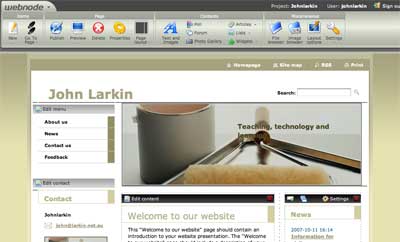
Last January I blogged about a new web publishing tool, WebNode. It is part of a new breed of web publishing tools that live entirely within the browser.

WebNode is an online tool that allows you to create functional and elegant web sites. The interesting thing about WebNode is that fact that you do not need to know the intricacies of html, css, xml or javascript in order to create the web site. You do not need to install or use any software.

Prior to the development of online tools such as WebNode users had to master web construction tools such as Dreamweaver, Microsoft Frontpage or others in order to develop a web site. Now, all the user needs to do is to put their existing ideas in order, gather together the necessary words and images and publish.

WebNode is forgiving and supported with a variety of plug-ins and widgets that together can make the job of online publishing straightforward, rewarding and fun. The construction process involves the use of templates and widgets that you can alter to meet your needs. In addition to this WebNode provides you with a rich statistics package that will help you to gain an understanding of the numbers and demographics of visitors to your site.

Recently I created a worksheet or “cheat-sheet” that provides an overview and hands-on guide for the tool. The worksheet is listed on my resources page with all of the other technology guides.

Good To Great Seminar ~ Singapore 2008
February 19th, 2008

This Sunday I am off to Singapore to participate in the Good To Great Teaching and Learning Seminar at Nanyang Technological University. The focus will be technology and how it can harness linkages between students, teachers and learning.

I have had the good fortune to attend the seminar in  2005, 2006 and 2007. In addition to the presentations there is a sequence of concurrent sessions and full day workshops for the participants.

This year I will be conducting workshops on blogging, mashups and new tools such as WebNode. Some of the workshop materials are available here. I am still mulling over the content for the presentation yet the focus that seems to be drawing me in is the world of core tools like blogs and wikis and the role that orbiting worlds like Twitter play in forging connections. Tied in to all of this is the possibilities afforded by Yahoo Pipes for example. I shall endeavour to share, blog or twitter as often as possible during the four days.

Empathy in history
February 19th, 2008

One of the attitudinal skills that students need to pick up as part of the course in history is a knowledge and appreciation of empathy. A strategy that I have employed  is to exhibit some dramatic and iconic images from history including the Hindenburg tragedy, the 2004 Asian earthquake and tsunami, Australian Ash Wednesday bushfires and the 1986 Challenger disaster. Still images and video are shown to the students.

The students are asked to comment and ask questions about the events and words that came up in the discussion include sympathy, shock, sadness and surprise. The students realise that the images are history. The text book has a dry old paragraph about empathy. They appreciate that history is about people. The students seemingly gain a grasp that history is about people and that people in the past have feelings, views, opinions and emotions as we do today.

Watching the video downloaded from YouTube and the images gathered via Picture Australia and Google search provided the visual resources that I needed for the lesson. The Internet proved very resourceful indeed.

I used Tooble on the Mac to download the videos from YouTube. Following download the flv files were converted on the fly into mp4 files and exported to iTunes.

Can anyone recommend a similar application for downloading and converting YouTube style embedded video files on the Windows XP or Vista platform?

WW1 ~ The experiences of an English soldier
February 10th, 2008

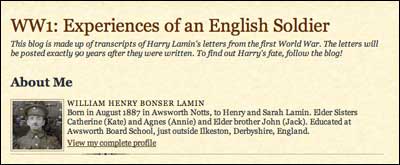
This morning, one of my colleagues, Flora, alerted me to this excellent historical blog. It is the WW1 letters of William Henry Lamin. As the blog author indicates the blog itself is made up of transcripts of Harry Lamin’s letters from the first World War. The letters will be posted exactly 90 years after they were written. This is not unlike the famous Pepys Diary I have blogged about elsewhere.

The details and comments provide minute detail regarding the life of an English soldier during the Great War 1914-1918. There are two related blogs that support the blog containing Harry’s letters. One blog is concerned with readers’ comments and the other is the official War Diary of the 9th Battalion of York and Lancaster Regiment.

These three blogs comprise an excellent resource of primary source evidence for students of history anywhere. I shall certainly be sharing these blogs with my Year Nine students and my other history teaching colleagues.