Thoughts on teaching, technology, learning and life in an era of change.

Archive for the ‘ History ’ Category

Teaching Australian history
September 22nd, 2008

Last weekend David Dale wrote an article in the Sydney Morning Herald regarding the teaching of Australian history in our schools. His article was prompted by the fact that the newly formed National Curriculum Board have commenced their meetings to start building a syllabus for History, English, Science and Mathematics. The new syllabus will come into effect in 2010. I am personally not sure how this new Board will achieve their goals given that they are only meeting on a few occasions and their numbers are few.

I personally have mixed emotions about the teaching of Australian history at present. More on that later.

I take exception to one Mr Dale’s statements, “Traditionally history lessons convinced kids Australia is one of the most boring places on the planet.” Which history lessons, Mr Dale? Elsewhere Mr Dale raises some good points. Yet, I wonder if he realises that all of the historical incidents that he listed in the article could not be taught in the current complusory Australian history course in NSW as they all took place before 1900?

Now, Australian history may not be as bloodthirsty or as thrilling as some episodes during the course of world history yet it is still possible to bring the content to life and make it relevant for the students.

One thing that annoys me about the teaching of Australian history here in NSW is that in recent years politicians have determined much of what and when we teach as opposed to historians and educators. This is frustrating. During the Howard years a jingoistic approach has crept into the teaching of the subject. Some politicians want teachers to be politically correct as we teach the subject.

I teach Australian history to Years 9 and 10 over a two year period. It is compulsory. I feel that the decision to make Australian history compulsory for students of Years 9 and 10 to be a poor decision. The syllabus content is tedious at times and admittedly it is challenging to engender interest and excitement in that specific content. The compulsory 100 hours of Australian history should be taught either to Years 7 and 8, either in a single 12 month period or over the two years in tandem with the Australian geography course. The Australian history taught should be comprehensive and not limited to the twentieth century.

Following that the Year 9 and 10 students should be allowed to select History as an elective. That elective subject should have a sweeping syllabus that covers world history, ancient through to modern and across all continents, including Australia. History should be an elective for the older students. The subject will attract a core of students interested in History. They can take that interest into senior subjects and then on to the community.

The politicians should leave the structure and content of the syllabus up to the teachers and not peddle their political or ideological agendas via our classrooms.

David Dale posed the question to his readers, “What should be in the core curriculum for Australian history?” A number of respondents suggest a wide range of topics and a number of students point out the boring aspects of the current syllabus. One students mentions how they are taught too much Australian history. This may not be entirely correct yet I can understand their sentiments given the structure of the syllabus.  We have limited hours in which to teach the course and as a result it is difficult to sink one’s teeth into the content.

A teacher Greg Leighton, put it rather well:

In NSW we have two constraints on good history teaching practice and they apply before any teacher gets into a classroom. Firstly, the Primary School syllabus limits Australian History content to the 19th Century if it is taught at all (with all the other subject and topics our overworked Primary teachers are required to do). Secondly, in High School we are limited to a shared (half) teaching load with Geography yet we still have a School Certificate exam. Because of this, content coverage is superficial in many areas in the interests of keeping our SC exam results at a satisfactory level. (Have a look at the SC Australian History exam sometime if you don’t believe the politicisation of the curriculum).

The ones who generally get forgotten are the students themselves, as has been shown by some of the earlier posts. I expect I’ll be howled down as one of those dreadfully biased teachers who ignores all the really important aspects of our history. However there are a lot of very dedicated History Teachers in NSW and no doubt across the country who would just like to be given a fair go at being able to deliver an interesting story that can both inspire as well as educate our students.

Other readers of David Dale’s article contributed salient points. Others did not. It makes an interesting read, particularly for teachers and students of Australian history.

And finally, one respondent Tony Flander made an impassioned plea that some of the lowest ebb of human decency should be taught. Do not worry Mr Flander, it is being taught. After all, History should at least engender in us all a desire not to repeat the errors of the past.
Historic Tale Construction Kit Tip Sheets
September 13th, 2008

During the last couple of weeks my Year Eights have had the chance to pay a few visits to one of our school computer labs. We have four Macintosh labs and they are almost constantly booked out. That is a good sign actually.

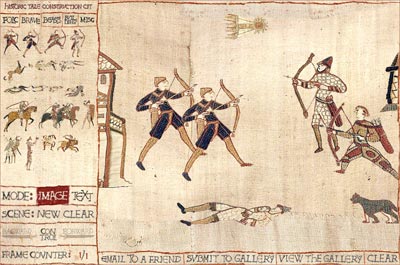
Anyway, I have been aching to share Historic Tale Construction Kit with my students and as our unit on the Middle Ages draws to a close I have booked them in to the labs and they have taken to the ‘kit’ rather enthusiastically.

I have created a couple of worksheets that the students can follow if they wish but, to be frank, one quick demo and a few hints is all they need. It is a little quirky at times. Sometimes a character element will freeze and cannot be deleted. There seems to be a limit to the number of elements one can include in a scene. These are very minor issues. It is quite a simple yet quite powerful little online programme. Links to the sheets below.

When they complete a scene I ask them to take a screen shot (as opposed to publishing it online), save the capture and then embed their collected scenes in Comic Life. [All you iPhone and iTouch fans might like to check out Comic Touch as well]

Of course, both Historic Tale Construction kit and Comic Life work just as well in a Windows environment.

At the end of the lesson I allow the class five minutes to play with PhotoBooth. I call it the PhotoBooth Moment. They enjoy it.

Links:

Historic Tale Construction Kit worksheet [doc]
Historic Tale Construction Kit tip sheet
[pdf]
Comic Life worksheet [doc]
Comic Life worksheet [pdf]
Earlier blog post on HTCK #1
Earlier blog post on HTCK #2

Twelve Canoes
September 8th, 2008

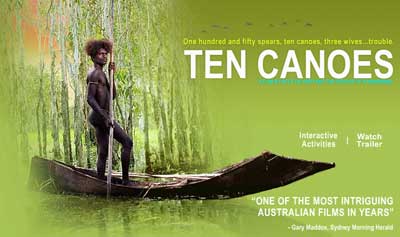
One of the most successful Australian films of recent years has been Ten Canoes. As the Wikpedia entry points out the film is “notable as the first full-length feature made entirely in an Indigenous Australian language. It was directed by Rolf de Heer and Peter Djigirr”. It is narrated by David Gulpilil and stars his son Jason. It provides rich insights into indigenous society and is an invaluable educational resource for all students.

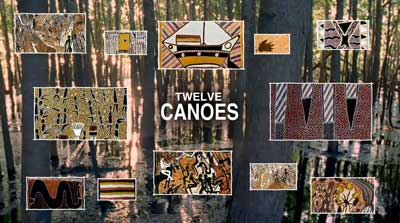
Today a new web site, Twelve Canoes, was launched. It is an evolution from the film Ten Canoes and continues the stories of the Yolngu people of the Ramingining in the northern part of Central Arnhem Land. This regions is located in the Northern Territory, Australia.

It is a beautifully designed web site that incorporates multimedia and other interactive elements. It is an excellent oral history resource. It is still evolving and will provide a rich resource for educators from primary through to the tertiary sector.

Year 9 and 10 History links updated
August 11th, 2008

Updated the Year 9 and 10 history pages last night. Added some links relevant to the local and national sites studies currently being undertaken by the students in those years.

Year Nine History links

Year Ten History links

Some of the sites are worthy, others not so worthy. The students will provide feedback on that. Included some Wikipedia entries as well. Referencing WIkipedia does not always go down well in some academic quarters. Often the external links at the foot of a Wikipedia page are useful.

I shall encourage the students to suggest more links. If you would like to suggest some local Illawarra History site or Australian historical sites of national interest please comment below.

Archaeology in the home
August 10th, 2008

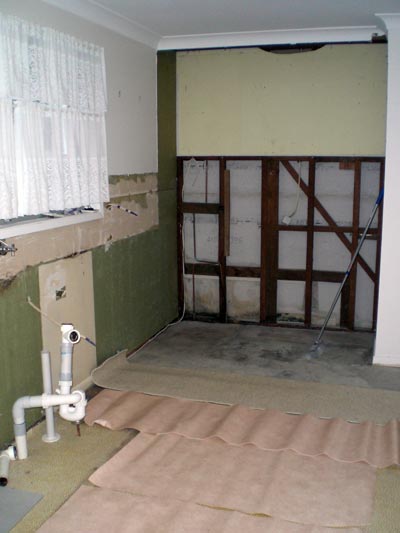
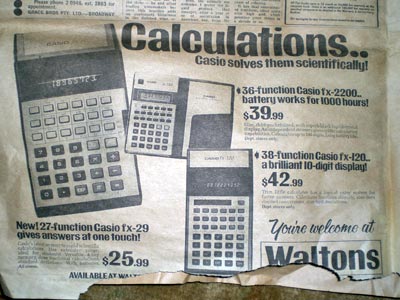
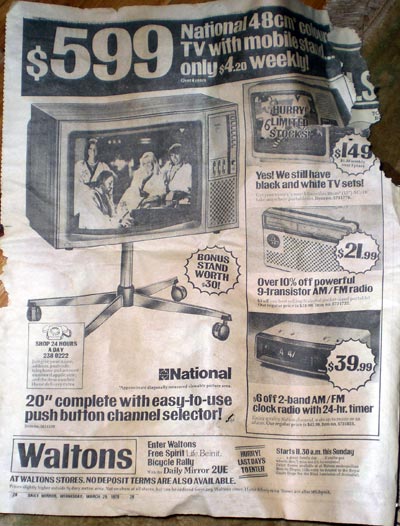
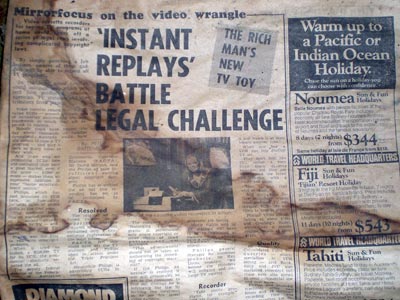
Our kitchen is being replaced. On Friday our old kitchen was removed. Back to the original walls and floors. We temporarily covered the floor to prevent accidents with nails protruding from the wooden part of the floor. Parts of the wall were removed. Inside one of the wall cavities were pages from a newspaper dated March 28th, 1978. I flicked through the pages and the items that caught my eye are illustrated below.

Advertisements for calculators that still give the impression of the revolutionary and brilliant this technology. Calculations… Casio solves them scientifically! I think our family obtained its first calculator in 1977.

Then there is this advertisement for a 48cm colour television with a price tag of $599-00AUD. That was an enormous amount of money back then. That may have been equivalent to a month’s salary for many people, perhaps more. The advertiser has used a photograph of ABBA on the TV screen. Love the AM/FM transistor radio and the bedside AM/FM clock radio. You still see those clock-radios in motels.

Finally, an article about the copyright problems posed by the rich man’s new toy, the video tape recorder. The article indicated thet there would be legal battles between manufactuers, television stations and home consumers of the product. Things have certainly changed in some respects.

We are going to put a current copy of the local paper, wrapped in plastic, back in the wall cavity for the next renovators to discover years from now. I wish there was an anachronism lying around I could throw in for good measure.