Thoughts on teaching, technology, learning and life in an era of change.

Archive for the ‘ Teaching ’ Category

Teachers and technology team up at school
June 15th, 2008

Recently a group of teachers at school met together during lunch to exchange technology tips and tools. The meet-up had its genesis couple of weeks back with a thought that I felt it would be good to team up with like-minded and positive thinking individuals and share ideas.

To be honest I have not been firing on all six cylinders in a spiritual sense of late and I needed perking up so instead of sitting there in the mud I felt why not create an opportunity for a group of positive and forward thinking individuals to get together and share ideas. That is certainly the best cure for the blues I know. Surround oneself with happy people. Fair enough?

I mentioned this idea after school one day to our Learning Technology Coordinator, Lynda, and an email went out to the staff inviting interested parties to attend our first lunchtime meeting. It happened just over a week ago. I have been buried in marking since then and this is the first chance I have had to sit down and clearly document that first get together

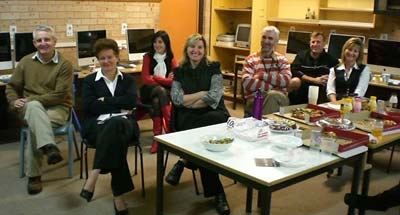
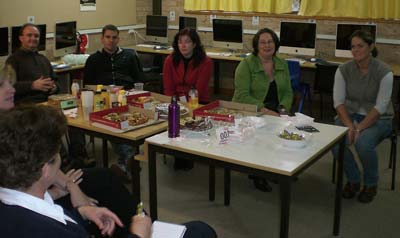
We met in Room 27, a Macintosh Computer Lab that is affectionately known as the “Cage”. In addition to myself there were 11 other staff members present: Lynda, Louise, Peter, Judy, Marion, Melanie, Michelle, Chris, Sandra, David and Steve. Teachers, librarians, support staff and administrators.
It is an informal group and the idea is simply to demonstrate tips and tools and to exchange notes. The emphasis is on sharing. At our first meeting Lynda got the ball rolling by sharing Mindmeister with the group.

Mindmeister logo

Lynda demonstrated how this online mind mapping tool could allow students and teachers to collaborate on mindmaps. As its own blurb points out, “users can create, manage and share mind maps online and access them anytime, from anywhere. In brainstorming mode, fellow MindMeisters from around the world (or just in different rooms) can simultaneously work on the same mind map – and see each other’s changes as they happen. Using integrated Skype calls, they can throw around new ideas and put them down on ‘paper’ at the same time.” It looks quite neat. Need to investigate that Skype interaction.
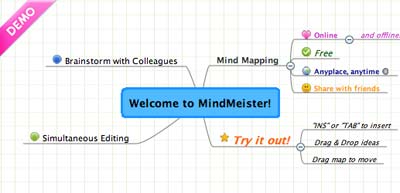
Mindmeister demo screen

Lynda followed this with a quick demo of Vixy.net. This service allows you to download YouTube videos reasonably easily. As the home page states, “it converts FLV to MPEG4 faster and less lossy than a typical transcoder“. David asked a question about conversion formats and we shared ideas regarding mp4, move and other video formats.

Vixynet logo

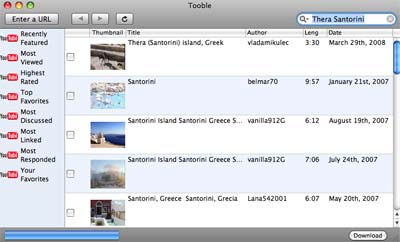
I mentioned Tooble with the team as well. It is a neat client side software tool that allows you to search YouTube and perform multiple downloads of selected YouTube videos. Mac or Windows.
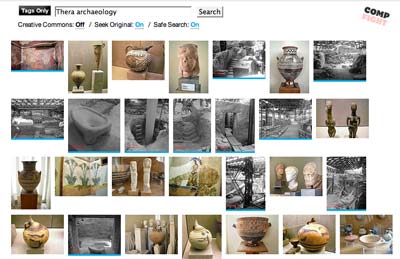
Following Lynda I gave a demo of CompFight, an unusually named online tool that allows you to search the Flickr image database rather easily.

I entered the terms Thera and archaeology into the search field and eighty nine excellent thumbnail images appeared. All were relevant to the current topic that I am teaching to Year Eleven Ancient History. The tool has a safe search mode.
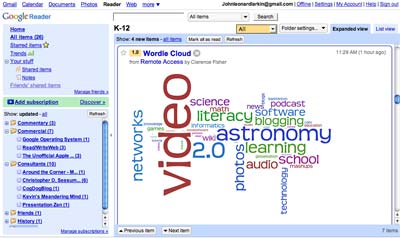
After that I demonstrated Google Reader and indicated how it allows the web to come to me rather than I reaching out to the web for news, ideas and tools. I illustrated some of the advantages of subscribing to blogs, del.icio.us links, flickr feeds, news media feeds and other sources.
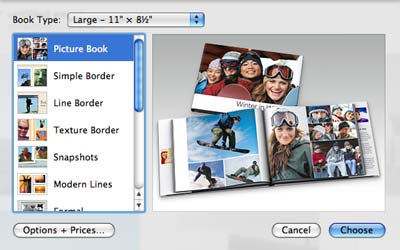
Then, Peter took the stage and gave an inspiring demonstration of the Photo Book feature within the Apple Mac app, iPhoto.

Peter has created some excellent ‘coffee table’ books illustrating the travels of his family and important events in the lives of his children. It is an excellent facility. Peter showed how one can employ the Autoflow setting to create the book, utilise templates and add text.
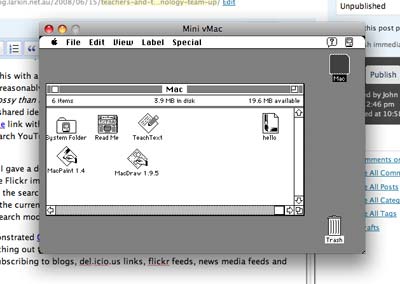
There was some spare time and I showed the group how I had set up a Mac 7.0.1 emulator on my MacBook Pro currently running Mac OS 10.5.2. Running the emulator is like stepping back in time 18 years. The software used is Mini vMac. It runs off a thumb drive.
We all enjoyed a nice meal of pizza, drinks and even a caramel mud cake. Lynda organised the food and drinks. Legendary Lynda! It was an excellent way to spend lunch. It may have been a cold and gloomy wintry day outside but within that room there was considerable collegial warmth and we all had a thoroughly good time. As I took a few photographs, with Peter’s help, I remarked on how excellent I felt the get together had been. We all had a great time.

Lynda wants to call us the Geek Group. I would like to call it, with a wry smile on my face, the Advanced Technology Group. Any suggestions?

Stay tuned for updates on following get-togethers.

How did I create this blog post? This blog post was created using WordPress. The web browser was Flock. The images were processed using Adobe Photoshop Elements. The images were uploaded to my web host, ICDSoft, using CyberDuck. The digital photographs were taken with a Casio EX-760 digital camera that resides in my pocket. The digital images were uploaded to my MacBook Pro using a MobileGear USB 2.0 card reader.
Classroom mobs, mayhem and murder
June 14th, 2008

Marc Prensky has had an article published over on edutopia, Young Minds, Fast Times: The Twenty-First-Century Digital Learner. I have mixed feelings about the article. I cannot help but feel that Marc has a habit of stereotyping teachers. There are good teachers out there. Many good teachers.

The article concludes with a synopsis as follows:

  • Talk to your students. They’re filled with great ideas on how to integrate tech into the classroom.
  • Lead by listening. Skip the classroom lecture and initiate discussions instead.
  • Ask students: What experiences in school really engaged you? How do you use technology in school as opposed to outside of school? What are your pet peeves?

This is already happening in many schools and classrooms.I agree, listening and talking to the students is a good idea. Gain their input.

Marc writes, “I’ve heard teachers argue that some subjects and topics need to have lectures, but, in truth, this is only a justification for the failure of those teachers to change how they teach.” I use lectures. It is one of the tools that I select from my backpack of teaching strategies. I do not stand there and speak parrot fashion. I roam, wander, gesticulate, grab props, involve students and tell the story. I share history. I live history. Many teachers adopt this approach. We all adopt many different approaches. Using the lecture is certainly no failure on my part. It is just one of the approaches I adopt and my students enjoy it. They look forward to it.

Not all classroom lectures are abysmal. I have been inspired and also entertained by great classroom lectures both at school and university.

Personally, I know I can engage the students with my historical recounts and storytelling. There is a place for classroom lectures. That form of instruction has a place in our society. It is a skill that should be shared with students. Their future careers may require the use of that skill at some time in the future. Who knows, they may become orators, speakers or even political leaders. The classroom lecture should not be simply cast aside or written off. Of course, the lecture can and should also be followed with discussion and shared input.

Marc writes that “we generally don’t make the slightest attempt to listen to, or even care, what students think about how they are taught”. I disagree, even on a general level. Myself and other colleagues are constantly listening to our students. That is how it is in the classrooms and playgrounds today. Students engage and share their opinions far more than ever before. Their thoughts and opinions are not always shared in a polite manner but at least they are shared. Students simply feel that their ideas are there to be shared. They talk, we listen.

In the past I have allowed some of my classes to vote on the topics that they wish to be taught. The syllabus allows this in some courses where a mandatory programme is not required to be taught. I must note that even the mandatory syllabus topics allow some scope for choice. The students have a diverse choice and in fact they can create their own case studies and areas of research.

Only, yesterday, as another example, I asked a class what they felt was the best way to tackle a particular activity. I shared with them that I personally was not all that good with drawing and artwork and as a result had no personal exemplars that I could share with them yet I was hoping that the class could use these skills in a new and collaborative way to rework what we have all been learinng together during this semester. We shared possibilities, mapped out some strategies and they got on with the task. The idea worked well for about 80% of the students present. Not all could handle the freedom allowed. They preferred to adopt a more prescribed approach and found it difficult to collaborate. On the whole the class enjoyed the opportunity to decide the approach they wished to take with the task ~ collages and posters relating to topics taught so far this semester ~ communism, cold war, Vietnam War, changing rights and freedoms, land rights, native title, indigenous peoples.

The students do have the opportunities to use technology and we do make use of the tools. Not as often as I would like but it still happens

I still have reservations regarding Marc’s digital natives versus digital immigrants dichotomy of the past that seems to underpin much of his thought in this article. There is no way that I am a digital immigrant simply due to my generational status. I have posted on this theme before… [ September 2007 | October 2007 ] I know that myself and many other of my colleagues actually use technology in a more meaningful and productive manner that nearly all 1000 students at our school. Only a few of the students at the school are actually publishing online and actually achieving productive or meaningful outcomes either as individuals or as members of a community. I do not believe that the use of MySpace and Facebook by some of the students qualifies as publishing. Admittedly, some of the students meaningfully write on their MySpace pages. Others, however, are simply trying to generate extensive lists of ‘friends’ and adding photographs. Is that writing and publishing? Sure the students can type and text faster than I yet not many have the knowledge and understanding of the possibilities of technology that myself and many of the teachers at our school possess.

The article by Marc was sub-titled, “How tech-obsessed iKids would improve our schools“. Please, no more cliche terms ~ iKids. For goodness sake, they are students and children. Why must they be labeled iKids? Perhaps the sub-editors at edutopia had a hand in that. Are they really obsessed with technology? I feel it is not an obsession. It is just part of their lives. Technology is just there. Not an obsession per se.

Marc Prensky states he is 62 years of age in the article yet he writes that, “it is a measure of the malaise of our educational system that these old folk — smart and experienced as they may be — think they can, by themselves and without the input of the people they’re trying to teach, design the future of education.” I find the term old folk to be derogatory and a slight. I am 49. What’s wrong with being old? I am sure there is some wisdom in those brains and and experience in those bones that hold us up. There are old teachers who are listening to students.

Students are providing inputs. Yet I must question, how many of our students today could actually provide valuable, constructive and significant input as to how students are taught now and in the future? Not that many. Indeed, there are students that are wise beyond their years. Yes, there are students that are creative, deep thinkers and capable of sharing rich foresight. Their thoughts, experiences and feelings should be tapped into by educators. Yet these students are not in the main. They are a subset of the general school population. Not all students are capable of providing a constructive input. How many students have a deep or meta understanding of technology, teaching and learning integration? Sure, some will, but not many. The same applies to all segments of the population. I have a feeling this may generate a comment or two.

Marc feels that by not allowing students to provide input into their education ‘is unacceptable and untenable’. He adds that “It’s also dangerous. Or else our students will drop out (as they are doing), shoot at us (ditto), sue us, riot, or worse.” Marc seemingly envisions a world with mobs, mayhem and murder in the classroom. Now I admit I am a little cynical and also pessimistic at times given climate change, food riots and our over dependence on oil but I cannot imagine a world with maniacal students and streets littered with dead educators.

This dire approach by Marc is clutching at straws. It is tabloid journalism. Did Marc Prensky really write that? I find it hard to believe that any educator worth their salt could write anything as sensational as that. Does he really believe that our students will assassinate us if we do not allow them to decide how they wish to be taught? Are students that angry about the current state of affairs? I cannot see it from where I teach. What does Marc mean by “or worse“? I wonder what could be worse than being shot at? Sent to Guantanamo Bay by a mob of student vigilantes, perhaps?

Marc writes that, “There are better ways to help them learn, and students expect us, as the adults in the room, to know how to use them.” Okay Marc, I would be happy to know the ways. I am eager to always learn something new.

Marc states that “Students universally tell us they prefer dealing with questions rather than answers, sharing their opinions, participating in group projects, working with real-world issues and people, and having teachers who talk to them as equals rather than as inferiors.” Well, that is exactly how students are taught in our school. That is how I teach.

Can I assume, according to the vibes Marc’s article is generating for me, that students elsewhere are schooled differently? I use ther term schooled as I feel it indicates a retrograde form of learning and teaching. Schools do need to change, but not all schools. Some schools are actually doing a good job.

Well, that was a bit of a rant I guess. Not fully formed. Seemingly unfinished. Perhaps some of my readers can help me to finish this post? Perhaps even finish it off! Well, get on with it John! Press that Publish button already!

Addendum. I forgot to add… I grow tired of the over the use of the term “Twenty-First Century” in relation to education. The fact that we are living during the 21st century has no bearing on how we teach and learn. It is all relative. Frankly, I have not been overly impressed with the 21st century to date. I think the human race will come to a crunching halt in the not too distant future if we do not curb our excesses. How will technology be manufactured when the oil reserves, real or otherwise, are no longer available? This century is not even a decade old.

Catching up in Singapore
May 9th, 2008

Been meaning to write this post for a week or so now. The return to school and a bout of the ‘flu got in the way.

During my last trip to Singapore I made the time towards the end of the trip to catch up with some friends, old and new. Usually I fly, conduct the workshops and fly out. This time I added in a weekend. It was well worth it. It was a nostalgia trip in some respects.

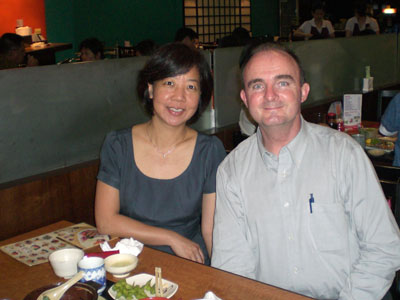
One evening I caught up with Sarah Teo. She is a senior staff member at U21Global, a cross between a senior project manager and senior instructional designer. We both worked at ICUS [recently purchased by Academee] together and collaborated on some eLearning projects for Singapore Airlines. Sarah was my project manager and I was the lead instructional designer during those days. I had a not too infrequent habit of leaving the office at about 5.30PM. I am sure Sarah would have been happier if I left later each day and put in a few more hours at work. I often worked late at home anyway, and the weekends, and public holidays.

Sarah and I at the Japanese restauarant

We had dinner at one of the old stomping grounds of the ICUS staff during lunch hours. We had a Japanese dinner. Sarah has been incorporating blogs, wikis and video conferencing tools, such as Seesmic, within the courses that she designs for U21Global. Sarah’s deployment of the tools has been quite progressive actually. I was quite impressed and wonder whether or not I may make a more permanent return to Singapore to be a part of these developments at some time in the future. If not Singapore, then maybe Taiwan.

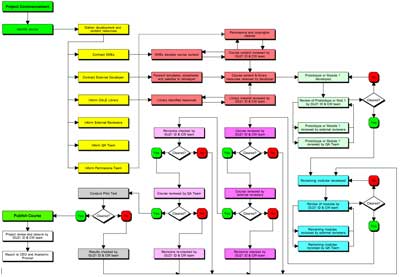
After leaving ICUS in April 2003 I had a break and returned to Australia for a couple of weeks to rest, and then returned to Singapore. I had about 6 weeks or so off altogether at the time. I was still teaching casually at the National Institute of Education. A few organisations contacted me regarding positions as an instructional designer. I was offered a job at U21Global to be the chief instructional designer back in June 2003. I spent some time there during the lengthy interviewing process and even developed a flow chart outlining my view of the course development process [doc][pdf] at U21Global. It’s a little imperfect and overly complex looking at it now. U21Global liked the general idea.

Proposed Course Development Process at U21Global

I turned down the offer, a difficult decision actually, and took a chance that I would be offered a position by Nanyang Technological University. The chance paid off and I soon began work at the Centre for Educational Development at NTU. It was great catching up with Sarah. Brought back a lot of memories and news of former colleagues.

Caught up with Siva during the trip. Seeing Siva is a must. Siva is easily one of my closest friends in Singapore. I met Siva while working on a cd-rom project for Knowledge Village. The focus of the cd-rom was mangrove environments and I was seeking subject matter experts. A search on the net turned up Siva. He was a researcher at the National University of Singapore and worked at the Raffles Museum of Biodiversity Research. I was quite an intense person at the time, probably due to the pressure being applied by Knowledge Village at the time. Too many projects, too few staff and too few resources. That is another story.

Siva and I share some Macintosh notes

Siva was a breath of fresh air. Siva and I hit it off immediately and then when we discovered we were Mac users we began swapping notes and ideas in earnest. Excellent! I became involved in some volunteer programmes around Singapore, as a result of meeting Siva, including the International Coastal CleanUp and simply fun things like the Pedal Ubin bike rides. Some of my galleries of those events are here: Pulau Ubin | ICCS 2001 | ICCS 2003 |

Siva has made excellent use of blogs in teaching his Biology courses at the National University of Singapore. In addition to his own excellent blog he has set up many others with his students and volunteers at the museum. Siva was blogging by phone using Bluetooth and other tools, out in the field, in the mangroves, to his original blog back in 2003, if not earlier.

Biodiversity Crew at NUS ~ check out the students’ field journal blogs!!!
Biology Refugia
ToddyCats
Pasir Panjang Heritage

On this trip Siva and I caught up during a MacMeetup. That was a great night. We talked about macs, blogs, blogging, publishing, censorship, politics, people, gear and so on. We all had to be kicked out of McDonalds at the end of the night.

I also caught up with Susan Sedro during the trip. Susan is a technology co-ordinator at the Singapore American School and she also has a rather elegant blog. We shared a nice breakfast at Causeway Point in Woodlands, not far from the school, early on the Saturday morning. We shared Singapore stories and previous career moves. Susan has also taught in Kuala Lumpur. I am always happy to meet other educators who make the move to destinations overseas.

Susan and I pose for a camera on a ten second timer

I was amazed by Susan’s stories of the International Schools Job Fairs. I never knew that these existed. [Note: Jeff Utecht at the SAS in Shanghai has blogged about similar job fairs]. I conducted a Blackboard LMS workshop or two at the Singapore American School back in late 2003 ~ early 2004. The school, as was other institutions in Singapore, was developing contingencies in the event of another SARS or similar outbreak. The SAS was also involved in the International Coastal Cleanups, mentioned earlier. Speaking with Susan, as well as Siva and Sarah earlier in the week, has reignited my interest in the region ~ in the sense of a more involved professional connection, as opposed to the quarterly trips.

Later on Saturday I caught up with Westley Field. Westley is Director of eLearning at Methodist Ladies College in Sydney. Westley and I were both graduates of the Masters’ Programme of the Faculty of Education at the University of Wollongong. We were both collaborating with the team at the Interactive Multimedia Learning Laboratory at the UOW and being guided and taught by Dr Barry Harper and Dr John Hedberg. They were the days of HyperCard and Macromedia Director.

Westley and I following a rather rich Malay lunch

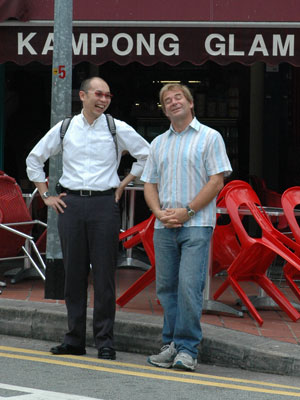
Westley was staying at the Hwa Chong Institution, where he was conducting a presentation on Skoolabarate, a Second Life collaborative project, the following day. We had dinner and a couple of drinks and the following day we met up with Alan Soong at Kampong Glam for an incredible lunch and also a very interesting round of desserts.

Alan grins as Westley hams it up in Kampong Glam

Alan was one of my students in the Masters’ programme at the National Institute of Education, Singapore. I was teaching casually at the NIE while one of my former lecturer’s from the Masters’ Programme at UOW, Dr Cheung Wing Sum was on leave. It was Alan that introduced me to the staff at the Centre for Educational Development at NTU where he was an instructional designer. It was not long before I had the good fortune to work at the CED. Alan, Westley and I had a great Sunday together.

Later that day I caught the plane home to Australia.

Read~write web workshop marks the end of a busy week
April 20th, 2008

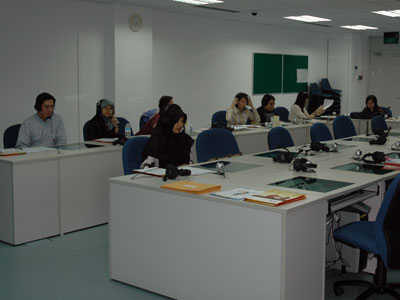
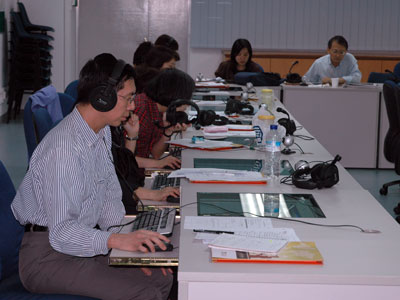
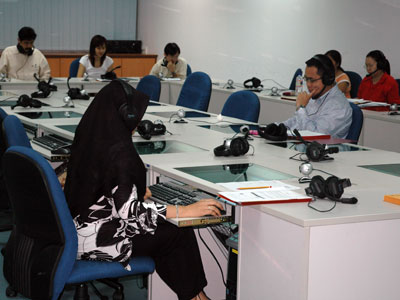
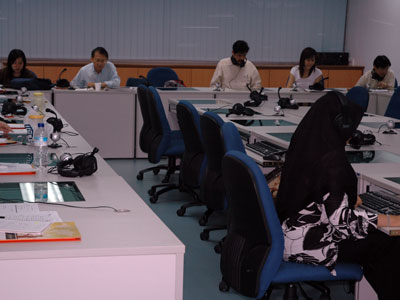
Friday saw my last workshop for this current excursion up to Singapore. It has been a busy week with workshops and presentations on each of the five days. The last workshop which was conducted in the School of Computer Engineering multimedia lab #3 at NTU covered blogs, wikis and podcasts. The tools we explored included WordPress, PBWiki, Audacity and Propaganda.

It was a hectic workshop as problems with WordPress slowed us down during the first half of the day. Why is the WordPress server so slow I ask? The PBWiki and podcast publishing functioned at lightning speeds given the 100mbps broadband connection in the lab. WordPress was sluggish. Pathetically slow. I switched across to Blogger at one point and its server was fast. No more WordPress workshops for me in future.

Participants from Nanyang Technological University, the National Institute of Education, Tan Tock Seng Hospital, Singapore Polytechnic and Marsiling Secondary School attended the workshop. It was an eclectic group of participants.

During the course of the week I had two loyal participants that attended nearly all my workshops at NTU this week… Ms Teo Juin Ee, a teaching fellow of the Curriculum, Teaching and Learning Academic Group at the National Institute of Education attended three of my sessions. As well, Mr Chang Boon Hai, Chief Information Officer at Singapore Polytechnic and Director of the Department of Computer & Information Systems at Singapore Polytechnic attended four of my sessions during the week. I feel honoured and also proud to share with educators of the calibre of Juin Ee and Boon Hai.


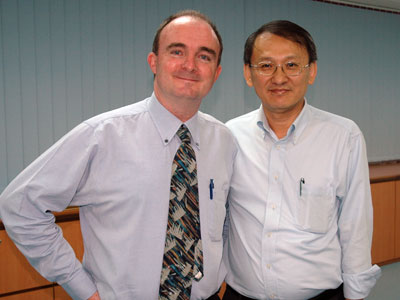
Mr Chang Boon Hai and myself

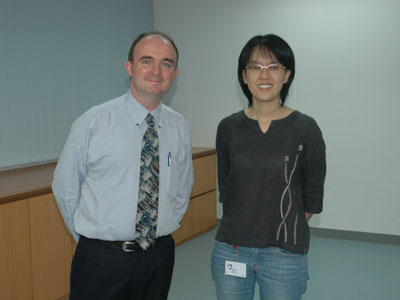
Ms Teo Juin Ee and myself

 The workshop moved along gradually during the day as I juggled with the temperamental WordPress server and a stomach-ache caused by a mix of Yakult and a roti-prata with curry combination. Please avoid the combination at all costs. It was as if I had a miniature volcanic experiment within my stomach. I am sure the rumblings within set off some seismic equipment within the Asia-Pacific region.

[You may note I am becoming reluctant to utilise the term Web 2.0. I think its currency is about to expire. I prefer to utilise the terminology read-write web. It seems to be a more appropriate descriptor. There is already a Classroom 3.0 Ning group. I just joined. Goodness gracious me. ]

Read~write web workshop at Hwa Chong Institution
April 19th, 2008

Last Thursday afternoon, after taking a taxi ride from the Singapore Airlines Training Centre to Bukit Timah Road, Singapore, I conducted a presentation and workshop at the Hwa Chong Institution in Singapore. The Hwa Chong Institution is a centre of learning excellence that evolved from a merger between the prestigious Chinese High School and the equally famous Hwa Chong Junior College. I felt quite honoured to receive an invitation from Jasmine Tey to conduct the workshop. We had met following my presentation at Nanyang Technological University last February.

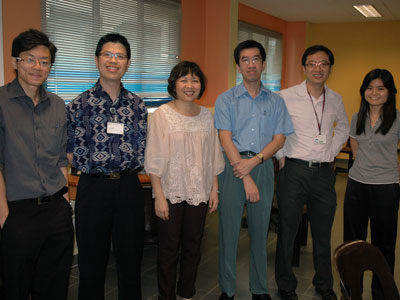
Jasmine Tey, centre, and some of her colleagues following the workshop

I covered such points as the evolution of the read~write web and the fact that the Internet allows for participation. We are no longer consumers but producers. We are no longer simply passengers along for the ride on the Internet. We are now guides and even drivers.

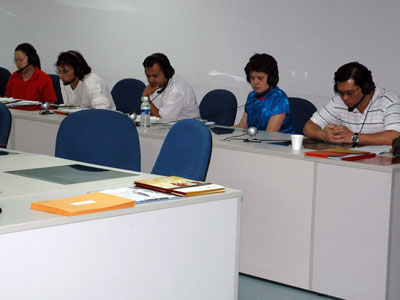
During the workshop…

We had a hands-on session with WordPress and we looked at a few other tools such as Twitter and del.icio.us. As I have blogged elsewhere, I am not too impressed with some of the new design aspects of the WordPress look and feel, the slow WordPress host server and the fact that javascript is no longer welcome.

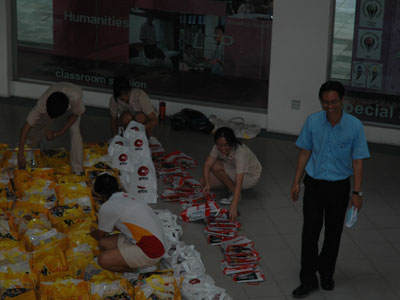
A teacher and his students preparing for an event

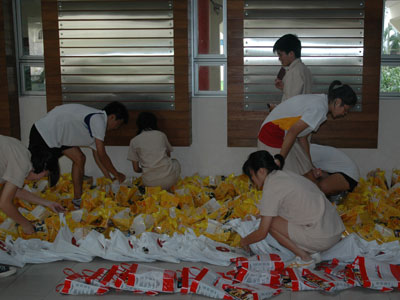
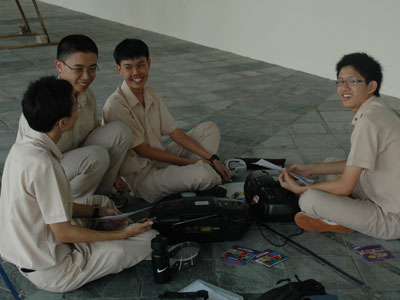
Following the workshop I took the opportunity to photograph some of the activities around the Institution. It is an amazing campus. Inspiring in fact. Jasmine and the team at Hwa Chong Institution took great care of me during the afternoon. They were all excellent hosts and I felt most welcome. It was a most valuable experience to visit and present at the Institution.

Students hard at work in their own time following school

Practising for a comedy sketch

Honour rolls and the school vision statement