Thoughts on teaching, technology, learning and life in an era of change.

Archive for the ‘ Web 2.0 ’ Category

Historic Tale Construction Kit ~ The Bayeux Tapestry 1066
April 5th, 2008

This morning I read about the Historic Tale Construction Kit in the Instructify blog. This web based application allows you to create a sequence of mediaeval events using images drawn from the Bayeux Tapestry. I believe that teachers of history that cover the middle ages would find this application very useful on a number of different levels.
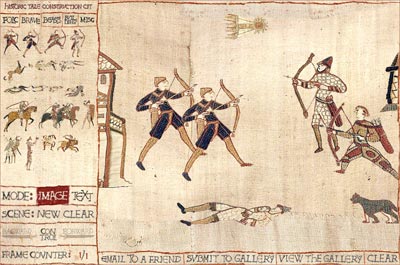
Teachers and students could recreate scenes from the tapestry and add additional text blocks that annotate the scene.

Scenes from the tapestry could be reworked thus generating arguments and controversies for debate. This could be considered a mediaeval form of “airbrushing” and “photo-retouching”. Discussion based upon “What if?” scenarios could be started.

The application allows the user to drag and drop a variety of characters, animals, beasts, plants, buildings and boats on to the canvas. These objects alone could be used as standalone focal points for analysis and discussion. You can also add authentic looking text to the canvas. They have even included Halley’s Comet which made an appearance in 1066 and was included on the original tapestry. You can create a sequence of scenes and advance from one to the next.

The user generated images can be emailed to a friend or sent to a gallery (although I could not get this to work). Savvy computer users could take a screen capture of the image, save it as a jpeg and then import it into a VoiceThread. Students could then add their own commentary to the image. They could also create an imaginative oral history based upon the characters in the mediaeval scene. The image in this post is a screen capture. Captured images could also be embedded in presentations, blogs and so on. There are opportunities for learning, debate, humour and fun. This is a captivating application.

It was a little buggy at times. I suspect that you can only drag a maximum of 9 or so objects onto the tapestry window. After that previously placed elements disappear. At times it appeared to freeze when you dragged an element on to the editing window from the palette at left. When embedding text you cannot place the cursor i-beam at the point you wish to re-edit. You have to use the delete or back-space key to return to the editing point. I was unable to publish to the gallery. My first attempt at using this online application can be found at this post.

I know that teachers of the Stage 4 History syllabus in NSW would find this a handy tool to use when teaching students about the society and people of the Middle Ages during Year 8 of their schooling. Students studying the Battle of Hastings will find it particularly useful.

As an aside I conducted a quick search for related sites and two of the more interesting were EuroDocs: Britain 1066-1485 which is a treasure trove of primary source material and The Bayeux Tapestry which provides a Quicktime VR panoramic view of the Bayeux Tapestry.

Links

Historic Tale Construction Kit
Medieval Sourcebook: William of Malmesbury, d. 1143?: The Battle of Hastings, 1066
Anglo-Saxon Sourcebook: The Battle of Hastings
The Battle of Hastings: A brief tour by Dr Deborah Vess
The Battle of Hastings according to Orderic Vitalis
J.P.Sommerville: The Battle of Hastings
EuroDocs: Britain 1066-1485
Britain’s Bayeux Tapestry at the University of Reading
Official site of the Bayeux Tapestry (French)
The Bayeux Tapestry
The Bayeux Tapestry ~ QuicktimeVR panorama
Wikipedia: Bayeux Tapestry and Battle of Hastings

—————-
Now playing: XTC – Senses Working Overtime
via FoxyTunes
How do you lifestream fellow educators?
April 2nd, 2008

I use Jaiku. A while back I attended a gathering of like minded individuals in Singapore keen on using the net in positive and innovative ways. During the get-together Kevin Lim introduced Jaikus to the group. I thought it was a neat tool. Kevin Lim is an instructional technologist, studying for a doctoral degree at Buffalo University. His web site is well worth exploring.

The Jaiku takes in feeds from my blog, twitter, flickr, last.fm and other sources. It sits on my home page and acts like a What’s New? for my entire site. It is a miniature lifestream I guess.Last October, it was bought by Google. You now have to request an invite to get a Jaiku. It has been like that ever since. What is happening there?

The embed code does not work in a post strangely enough. WordPress strips out some of the code.

Addendum in the afternoon, after school. I added it to the sidebar instead. Looks pretty, eh?  That sidebar is chock-a-block full or crap. Need to clean it up a bit. What should go?

Diigo in education ~ this is crazy man!
March 30th, 2008

At least two Diigo education groups have been created in the last three days. Think about it. There are many more similar groups on Diigo. Which one should I join? Should I join them all?

Help!!!! This is all getting a little out of control. I feel like it is the middle ages, a convicted criminal, four horses attached to my four limbs and they are all galloping in a different direction. Should I join that Ning? Should I follow that group? What about Diigo? Yeeeaaaagggghhhhhhh!!!!!!!

Time to move to another planet. At least get out and take some photographs and have a  quiet beer.

Twitter surprise from Flocker
March 23rd, 2008

About a day or so ago I exchanged a couple of brief notes via Twitter with edublogger par excellence Clay Burrell regarding the Flock browser. I mentioned that I liked Flock but was disappointed that I could not post directly to my self- hosted WordPress blog. It has trouble recognising the api I think. Prior to that I could post directly to my old Blogger blog. It is a neat tool as you automatically gather the urls and images into the post via Flock’s excellent feature set.

Well, I was glancing through my tweets this morning and here is this tweet from the Flock team asking how can they help with my Flock problem. That is amazing. I wasn’t even following Flock.

Think about it. If I had commented on my Mac or something to do with Microsoft Office would I have received a tweet from those organisations? I replied and I now await their response.

Update: Monday 24th March. Flock replied to my twitter response and provided me with the email address of one of their staff members. Excellent service!

Christopher D. Sessums on Social Networks
March 22nd, 2008

Christopher D. Sessums has written on social networks and he has used the agora of the ancient Greeks as an analogy. He writes that the “various social and participatory applications available to us can serve… as a place where people can freely examine a wide range of ideas and ideals.”

I will not attempt to paraphrase all of Christopher’s post yet he asked a couple of questions that resonated with me. He writes:

“But the next step requires us to be reflective. The Internet and Web have afforded us an opportunity to re-examine and re-define our morals, our communities, our nations, and the globe. But will these conversations be limited to only a few? What mechanisms are in place to encourage and support a wide range of thought and activity?”

I have wondered about the conversations of late and the diversity of thought within the edublogosphere and at least within the blogs that I read there seems to be a sameness creeping into the environment. I articulated these thoughts a little further on Christopher’s blog. Something along these lines…

I feel that his two questions, as quoted above, are timely and they need to be asked. I have sensed of late that segments of the “edublogosphere” are dominated by a small coterie of seasoned bloggers who are followed by a dedicated core of disciples that hang off their every word. I think this is stifling original thought and creating a sameness in some edublogging arenas. The conversations are limited to a few yet cloned by many.

I have observed a number of new edubloggers join the networks of late and they soon become mirror images of the more seasoned or ‘vocal’ edubloggers. It is a pity. I feel that the twitter networks play a role in the establishment of this sameness.

“What sort of mechanisms can we set up to encourage creativity and diversity among edubloggers?” I agree that the world of education bloggers should be more like an agora with a highly varied range of discussions, debates, marketing of ideas and the ‘playing of games’ (as per an agora). The agora of ancient Athens was largely responsible for the creation of democracy, philosophy and western thought.

At the moment I fear that the edublogosphere is evolving into a collection of shopping malls populated with overly dominant voices that are differentatiated only in the way that they are branded. We do need more voices. Different voices.

Looking at Christopher’s blogroll I also think it is time I explored a few new voices and joined a few new networks.